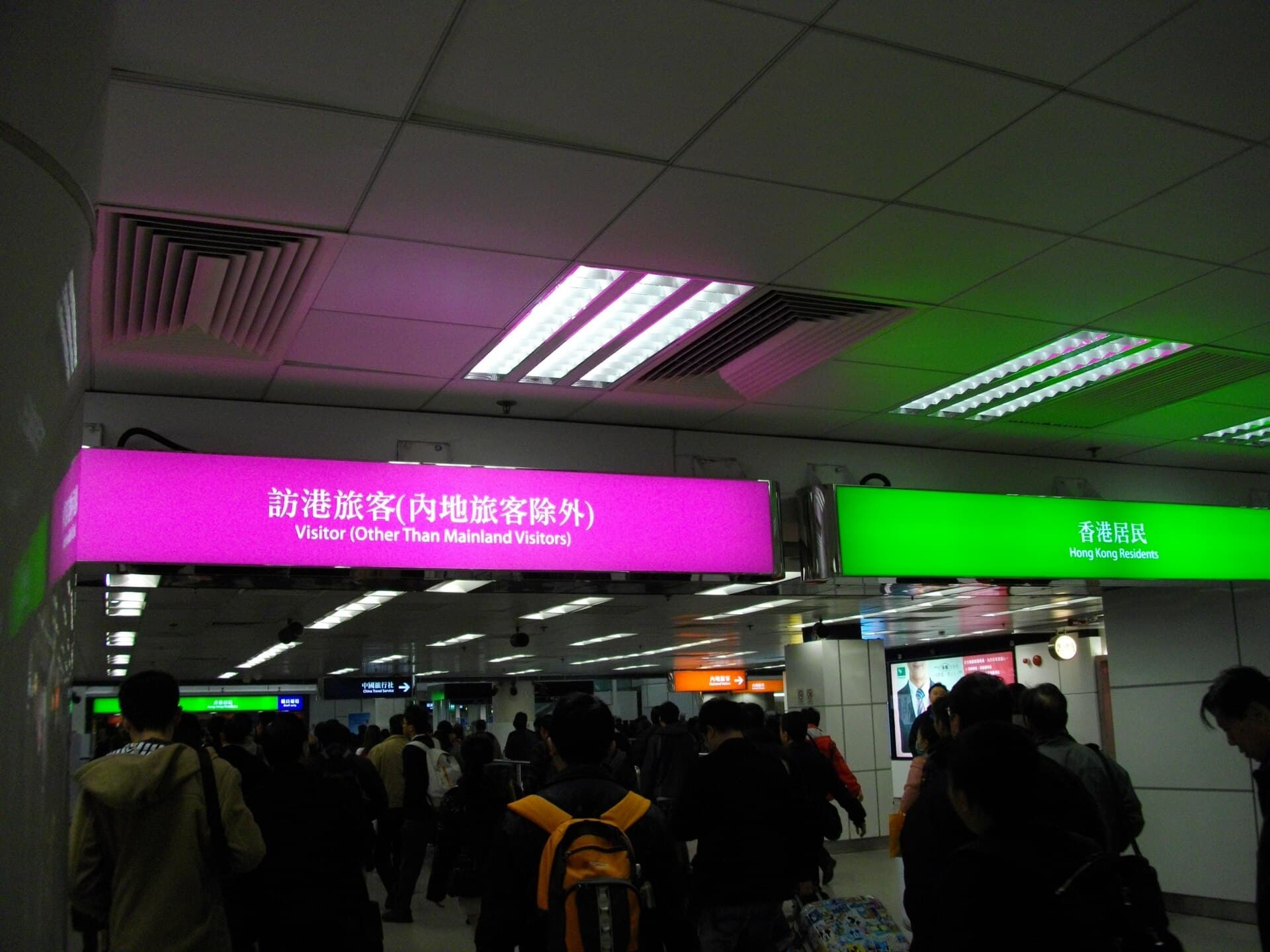
Landing capability

Crossing from Hong Kong to Shenzhen by land

In short

Which crossing do I use, and until when is it open?

For foot passengers, Lo Wu (to Luohu) or Lok Ma Chau Spur Line (to Futian) by rail; by bus or car, Shenzhen Bay or the Lok Ma Chau vehicle point (to Huanggang). Only 2 crossings run 24 hours — the Lok Ma Chau vehicle point and the Hong Kong-Zhuhai-Macao Bridge; the pedestrian ports close between 10:30 pm and midnight. A land crossing is 2 immigration checks — Hong Kong exit, then mainland entry — not the single arrival desk of an airport.

Back to the entry hub

Applies to

A foreign visitor based in Hong Kong who adds a Shenzhen day or leg and crosses by land — on foot by rail, by cross-boundary bus or car, or by high-speed rail from West Kowloon.

Check before you rely on it

Port hours are from the Hong Kong Immigration Department and the Shenzhen government and can change; bus timetables and fares are commercial and not published as an official rule. Confirm your crossing's hours before a late return.

Information checked:

The airport taught you a single arrival hall that is always open. A land crossing is neither: it closes overnight, and it is two immigration checks — you exit Hong Kong, then enter the mainland.

Pick your port, mind its hours

The crossings, their two names, and when they close

Hong Kong-side hours from the Immigration Department; mainland-side names and hours from the Shenzhen government. Sources read 2026-08-08.

Hong Kong side (hours)Mainland side (hours)What crosses here
Lo Wu6:30 am to midnight

Source: Immigration Department, Government of the Hong Kong Special Administrative Region (immd.gov.hk), official English site — Control Point Locations (source standing directory page; read August 8, 2026)

Luohu Checkpoint6:30 am to 12:00 am

Source: Nanshan District People's Government of Shenzhen (szns.gov.cn), republishing the Shenzhen municipal English portal (eyeshenzhen.com) — Checkpoints in Shenzhen (source updated 7 November 2024; read August 8, 2026)

Foot passengers by rail — the MTR East Rail Line at Lo Wu connects to Shenzhen Metro Line 1 at Luohu. The busiest pedestrian crossing.
Lok Ma Chau Spur Line6:30 am to 10:30 pm

Source: Immigration Department, Government of the Hong Kong Special Administrative Region (immd.gov.hk), official English site — Control Point Locations (source standing directory page; read August 8, 2026)

Futian Checkpoint6:30 am to 10:30 pm

Source: Nanshan District People's Government of Shenzhen (szns.gov.cn), republishing the Shenzhen municipal English portal (eyeshenzhen.com) — Checkpoints in Shenzhen (source updated 7 November 2024; read August 8, 2026)

Foot passengers by rail — the East Rail Line spur at Lok Ma Chau connects to Futian, in central Shenzhen. Closes earlier than Lo Wu.
Lok Ma Chau (vehicle control point)24 hours

Source: Immigration Department, Government of the Hong Kong Special Administrative Region (immd.gov.hk), official English site — Control Point Locations (source standing directory page; read August 8, 2026)

Huanggang Checkpoint24 hours every day

Source: Nanshan District People's Government of Shenzhen (szns.gov.cn), republishing the Shenzhen municipal English portal (eyeshenzhen.com) — Checkpoints in Shenzhen (source updated 7 November 2024; read August 8, 2026)

Cross-boundary coaches, shuttle buses, goods vehicles and private cars. One of only two crossings that never close.
Shenzhen BayPassenger clearance 6:30 am to midnight; goods vehicles 24 hours

Source: Immigration Department, Government of the Hong Kong Special Administrative Region (immd.gov.hk), official English site — Control Point Locations (source standing directory page; read August 8, 2026)

Shenzhen Bay Checkpoint6:30 am to 12:00 am

Source: Nanshan District People's Government of Shenzhen (szns.gov.cn), republishing the Shenzhen municipal English portal (eyeshenzhen.com) — Checkpoints in Shenzhen (source updated 7 November 2024; read August 8, 2026)

Buses and cars, in a single building where the Hong Kong and mainland immigration facilities are co-located — you clear both sides under one roof.
Express Rail Link West Kowloon6:30 am to 11:30 pm

Source: Immigration Department, Government of the Hong Kong Special Administrative Region (immd.gov.hk), official English site — Control Point Locations (source standing directory page; read August 8, 2026)

Mainland Port Area inside West Kowloon Stationcleared inside Hong Kong before boarding (co-location)

Source: Government of the Hong Kong Special Administrative Region (info.gov.hk), Government Information Services press release — Guangzhou-Shenzhen-Hong Kong Express Rail Link (Co-location) Ordinance comes into operation (source dated 4 September 2018; read August 8, 2026)

High-speed rail to Shenzhen, Guangzhou and beyond. Mainland immigration is done inside the Hong Kong station, so you arrive already admitted — see the note below.

The published facts

What a land crossing actually is

Each line links the official page and the day we read it. Sources read 2026-08-08.

A land crossing has a closing time

Unlike an airport, most crossings shut overnight. Only the Lok Ma Chau vehicle point and the Hong Kong-Zhuhai-Macao Bridge run 24 hours. The pedestrian ports a foot passenger uses — Lo Wu and Shenzhen Bay close at midnight, Lok Ma Chau Spur Line at 10:30 pm — so a late dinner in Shenzhen can strand you if you assumed the border was always open.

Source: Immigration Department, Government of the Hong Kong Special Administrative Region (immd.gov.hk), official English site — Control Point Locations (source standing directory page; read August 8, 2026)

It is two immigration checks, not one

A land crossing is two controls: you clear Hong Kong exit, then mainland entry. The Shenzhen government's own guide spells out the Wenjindu sequence — you stop first at the Shenzhen (mainland) gate house and complete the immigration process, then cross to Hong Kong immigration — so plan for two counters, not the single arrival desk you get at an airport.

Source: Nanshan District People's Government of Shenzhen (szns.gov.cn), republishing the Shenzhen municipal English portal (eyeshenzhen.com) — Checkpoints in Shenzhen (source updated 7 November 2024; read August 8, 2026)

Shenzhen Bay is one co-located building

The Shenzhen government describes Shenzhen Bay as the first boundary control point with the Hong Kong immigration facilities co-located in the same passenger terminal building as the mainland side, so departure and arrival clearance take place a short distance apart under one roof.

Source: Nanshan District People's Government of Shenzhen (szns.gov.cn), republishing the Shenzhen municipal English portal (eyeshenzhen.com) — Checkpoints in Shenzhen (source updated 7 November 2024; read August 8, 2026)

The mainland ports, named

The National Immigration Administration's own announcement names Shenzhen Bay Port in Shenzhen and Gongbei Port in Zhuhai as the mainland land ports — Shenzhen Bay is the mainland side of the Hong Kong Shenzhen Bay crossing, and Gongbei is the mainland side of the Macau Border Gate crossing.

Source: Exit and Entry Administration, P.R.C. / National Immigration Administration (en.nia.gov.cn) — Announcement on the Launch of 'Document-Free' Channels at Ports of Shenzhen Bay and Gongbei on a Trial Basis (No. 9 [2024]) (source No. 9 [2024], dated 15 November 2024, effective 20 November 2024; read August 8, 2026)

The 'document-free' lanes are not for a foreign passport

News of 'document-free' channels at Shenzhen Bay and Gongbei can make a visitor think they can walk through without a passport. The regulator's text scopes those lanes to Chinese mainland residents with Hong Kong/Macao permits and to Hong Kong/Macao SAR residents (including non-Chinese residents) with Mainland Travel Permits — not to ordinary foreign tourists. As a foreign visitor you present your passport at a staffed / standard channel.

Source: Exit and Entry Administration, P.R.C. / National Immigration Administration (en.nia.gov.cn) — Announcement on the Launch of 'Document-Free' Channels at Ports of Shenzhen Bay and Gongbei on a Trial Basis (No. 9 [2024]) (source No. 9 [2024], dated 15 November 2024, effective 20 November 2024; read August 8, 2026)

By high-speed rail: you clear the mainland border inside Hong Kong

At West Kowloon Station a Mainland Port Area applies mainland immigration and mainland law on Hong Kong soil (the co-location arrangement, operating since September 2018). You clear both sides in one building before boarding and arrive in Shenzhen or Guangzhou already admitted — there is no second border stop at the far end.

Source: Government of the Hong Kong Special Administrative Region (info.gov.hk), Government Information Services press release — Guangzhou-Shenzhen-Hong Kong Express Rail Link (Co-location) Ordinance comes into operation (source dated 4 September 2018; read August 8, 2026)

Exit one side, enter the other

Five steps across the border

  1. 1.Pick your port by its hours, not just its location: if you might return late, a crossing that closes at 10:30 pm or midnight can strand you — only the Lok Ma Chau vehicle point and the Hong Kong-Zhuhai-Macao Bridge run 24 hours.
  2. 2.Carry the passport you entered Hong Kong on; a foreign visitor uses the passport channel, not the document-free lanes reserved for Hong Kong/Macao permit holders.
  3. 3.Clear Hong Kong exit control first — this is the departure side, and it is a full immigration check, not a formality.
  4. 4.Cross to mainland entry control and present your passport (and complete the Arrival Card if it applies — see the visa-free / arrival-card page). Remember the mainland uses a different name for the same port.
  5. 5.By high-speed rail from West Kowloon, both checks happen inside the Hong Kong station before you board, so you step off in the mainland already admitted.

By high-speed rail

The border you clear inside Hong Kong

Why the West Kowloon crossing surprises first-timers, from the Hong Kong government's own press release.

  • At West Kowloon Station a Mainland Port Area applies mainland immigration and mainland law on Hong Kong soil. You clear both sides in one building before boarding and arrive already admitted — no second border stop at the far end.
  • The West Kowloon control point runs 6:30 am to 11:30 pm, so the last high-speed trains are timed to it — miss the window and you fall back to a road or rail crossing.

In short

Land-crossing questions a visitor asks first

Which port, why two names, the document-free trap, and how it differs from flying in.

Which crossing do I use from Hong Kong to Shenzhen, and until when is it open?

For foot passengers, Lo Wu (to Luohu) or Lok Ma Chau Spur Line (to Futian) by rail; by bus or car, Shenzhen Bay (a co-located building) or the Lok Ma Chau vehicle point (to Huanggang). Only the Lok Ma Chau vehicle point and the Hong Kong-Zhuhai-Macao Bridge run 24 hours — the pedestrian crossings close between 10:30 pm and midnight, so pick your port by its hours if you plan a late return.

Why do the two sides use different names for the same crossing?

Because each side names its own facility. Lo Wu on the Hong Kong side is Luohu on the mainland side, Lok Ma Chau Spur Line is Futian, and the Lok Ma Chau vehicle point is Huanggang. Once you are through Hong Kong exit control, follow the mainland name.

Can I use the 'document-free' fast channels I read about?

No. The document-free channels at Shenzhen Bay and Gongbei are for Chinese mainland residents with Hong Kong/Macao permits and for Hong Kong/Macao residents with Mainland Travel Permits, not for ordinary foreign passports. As a foreign visitor you present your passport at a staffed channel.

How is a land crossing different from arriving by air?

It is two immigration checks, not one: you clear Hong Kong exit, then mainland entry (or, by high-speed rail from West Kowloon, both inside the Hong Kong station before boarding). And it has a closing time — an airport arrival hall does not.

Could not confirm

What this page will not assert

Facts that circulate widely but were not on a page we could open. We leave them here rather than guess.

  • Cross-boundary bus and coach timetables and fares (for example the Lok Ma Chau–Huanggang shuttle) are commercial operator specifics and were not confirmed on an official page; only the fact that Lok Ma Chau is the 24-hour Hong Kong vehicle control point is sourced.
  • The daily operating hours of the Macau Border Gate (Portas do Cerco) / Gongbei Port — often cited as 6:00 am to 1:00 am — were not confirmed on an official page we could open, so we do not publish a figure. The opened Macau-side anchor is the round-the-clock Qingmao Checkpoint, which is designed for Macao ID holders and registered users, not the default foreign-visitor crossing.
  • Whether a Hong-Kong-based visitor who day-trips to the mainland and returns can rely on visa-free transit is a separate question, because transit requires an onward ticket to a third country or region — see the visa-free-and-arrival-card page, which sets out the condition.

Do visa-free and the Arrival Card apply here?

The companion page: whether the visa-free transit rule and the online Arrival Card work at a land port the same way as at an airport.

Open page

The arrival inspection

What the mainland entry check involves once you are through Hong Kong exit control.

Open page

High-speed rail across China

The wider rail network the West Kowloon crossing plugs you into once you are admitted.

Open page

Next move

Leave each page knowing what to do next.

Read enough to make the decision smaller, then open the checklist, search a specific question, choose a setup tool, or share the page with the person planning with you.

Official sources for rules, fares, payments, safety, and device setup.
Written around the day-one jobs: pay, connect, move, eat, get help.
Recommendations stay attached to a traveler task.

I need the next step

Use the checklist when the question has shifted from research to preparation.

Open checklist

I know the problem

Search by the actual problem: Alipay, eSIM, transit visa, first transfer, vegetarian food, or a city name.

Search the site

I am ready to choose

Open recommendations when the task is clear enough for a short list to be useful.

See recommendations