I need the next step
Use the checklist when the question has shifted from research to preparation.
Shanghai · fares by rule
In short
Shanghai sets its taxi meter and rail fares by rule, not by the driver. A downtown cab starts at ¥14 for the first 3 km, then ¥2.7 per km, with 30% added between 23:00 and 05:00 and a government-guided ±5% band by time of day; municipal-area rail is distance-priced from a ¥4 minimum. If a fare looks wrong, call 12328 for a taxi complaint or 12345 for the city hotline.
Street-taxi guideApplies to
Visitors taking downtown cruising (street or ranked) taxis and municipal-area rail inside the Shanghai administrative area.
Check before you rely on it
These are Shanghai-only regulated figures. District and accessible cabs are priced separately, the ordinary downtown subway's per-segment table is a different document, and every other Chinese city sets its own tariff — so do not carry these numbers elsewhere.
The point of a metered city is that you can check the driver's number against the rule. Below is the Shanghai meter, the rail distance mechanism, and the city channels to call — each with the official page it was read from.
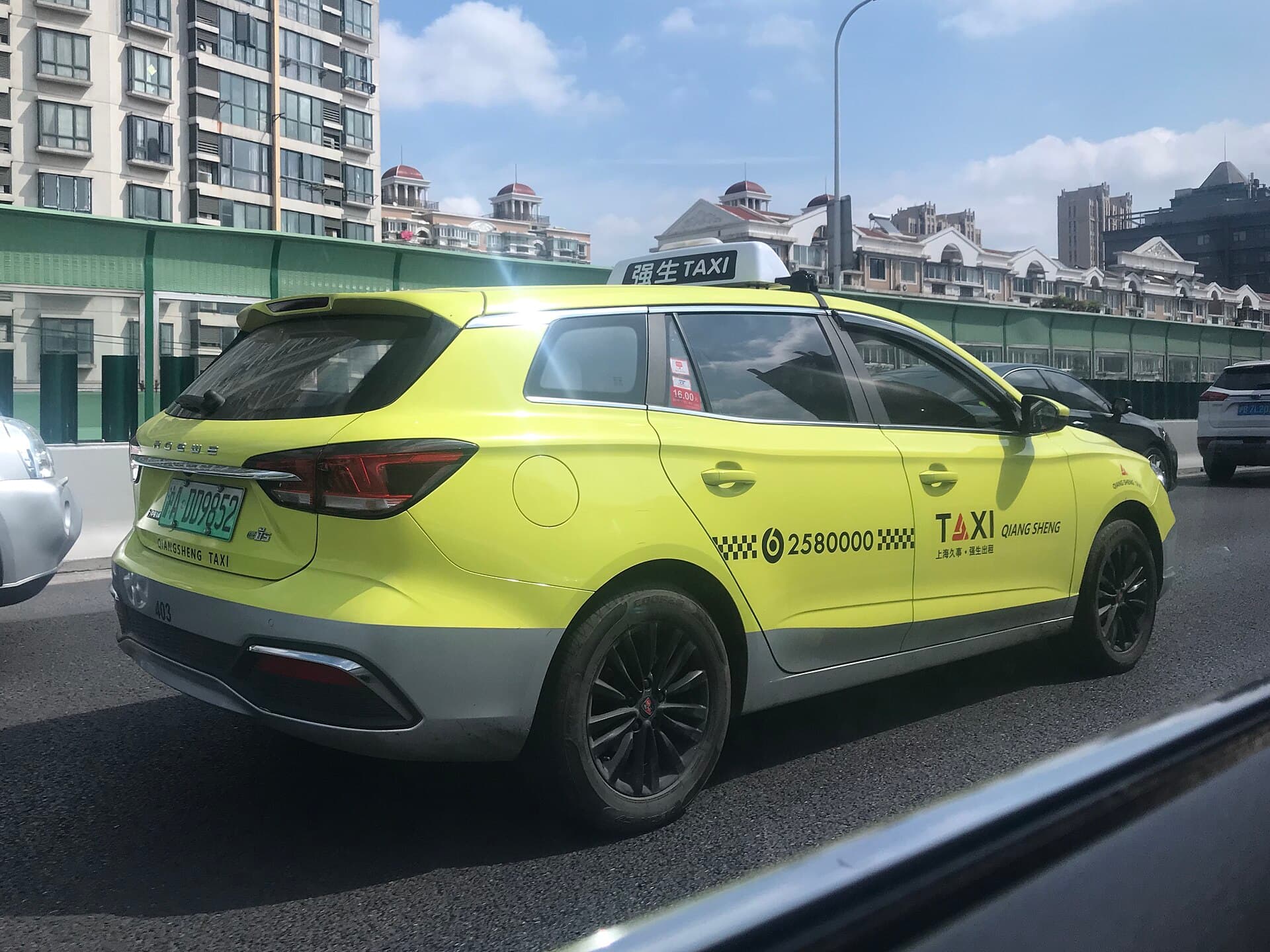
This is the car type the fare standard treats differently: Touran-type and Roewe Ei5 cabs start at ¥16 for the same first 3 km, against ¥14 for a standard downtown cab. A higher start here is the rule, not overcharging — which is why it is worth being able to recognise the car.
Photograph by Jengtingchen, CC BY-SA 4.0 — source and licence
Official rules · read August 8, 2026
Four official Shanghai pages: the municipal taxi fare standard, the price authority's municipal-area rail notice, and the Transport Commission's hotline and complaint-desk pages. Each row states what it means for you, the figure verbatim, and where in the rule to check it.
| What it means for you | What the rule states | Where in the rule |
|---|---|---|
| The meter is fixed by rule: ¥14 for the first 3 km, then ¥2.7 per km | Shanghai's downtown standard sets the flag-down at ¥14 covering the first 3 km — the boarding price already includes mileage, so it is “¥14 for 3 km”, not “¥14 flat” — and a base rate of ¥2.7 per km beyond it. The driver does not choose this, and the numbers differ from Beijing (¥13 / ¥2.3 per km), which is exactly why this is a Shanghai-specific rule rather than a national one. | 市区客运出租汽车 · 起租 / 超起租 |
| Touran-type and Roewe Ei5 EV cabs start at ¥16 for the first 3 km | Larger Touran-type cabs and Roewe Ei5 electric cabs have a ¥16 flag-down for the same first 3 km rather than ¥14. The higher start is set by the standard, not the driver — so it is a legitimate car-type difference, not overcharging. | 市区客运出租汽车 · 起租(大型 / 纯电车型) |
| A stuck taxi keeps billing — the low-speed / waiting rule, not the driver cheating | Below 12 km/h, or when you ask the cab to wait, the meter bills 1.5 km of the beyond-flag-down rate every 4 minutes. This is why a taxi crawling in Shanghai traffic still climbs, and it is the fact most likely to read as overcharging to a first-timer — it is the tariff, applied by speed. | 加价部分 (3) |
| A ride between 23:00 and 05:00 is billed 30% more — the exact late-arrival window | From 23:00 to 05:00 the rate rises 30% (note Shanghai's night bump is +30%, higher than Beijing's +20%). That is the surcharge a late-night flight actually pays, so a higher after-midnight fare is a rule and not the driver improvising a night price. | 加价部分 (2) |
| Past 15 km, the base rate climbs 50% | On the portion of a trip beyond 15 km the per-km rate goes up 50%. Cross-city and long airport runs are often that far, so this — stacked on any night surcharge — explains a higher-than-expected fare without anyone overcharging you. | 加价部分 (1) |
| A holiday arrival pays a stated per-trip add-on: ¥10 at Spring Festival, ¥5 at National Day and May Day | During the Spring Festival holiday a ¥10 per-trip surcharge applies, and during the National Day holiday and the Labour Day (May 1) short holiday it is ¥5 per trip. The exact holiday dates are set by the State Council each year. It is a legitimate line on the fare, not padding added because you are a foreigner. | 加价部分 (4) |
| The base fare rides a government-guided ±5% band, so it can move a few percent by time of day | The joint transport-and-price notice (沪交道运〔2021〕1119号, in force since 2022-01-15) moved the meter from a fixed price to a government-guided one on a +5% / 0 / −5% band. At peak (07:00–10:00 and 16:00–19:00 on non-holiday weekdays) the operator may add +5% or stay flat; off-peak (10:00–16:00) it may cut −5% or stay flat. So a legitimate fare can sit up to 5% above or below the headline numbers depending on the time and operator. | 浮动运价 · 沪交道运〔2021〕1119号 |
| These numbers are the downtown meter only — district and accessible cabs are priced separately | This is the downtown (市区) cruising-taxi standard. District (区域性) taxis are priced by each district government and wheelchair-accessible cabs are priced by the operator. So do not carry ¥14 / ¥2.7-per-km to every cab in the wider municipality — that is the boundary the standard itself draws. | 适用边界 |
Read off: Shanghai Municipal Transportation Commission (上海市交通委员会) — 本市出租汽车运价结构和收费标准 (Shanghai cruising-taxi fare structure and charge standard) (page dated 2023-05-15; float band under joint notice 沪交道运〔2021〕1119号; read August 8, 2026)
| What it means for you | What the rule states | Where in the rule |
|---|---|---|
| Shanghai rail is distance-priced: fare = per-km rate × distance, with a ¥4 minimum | The price authority's own notice states 每人次票价 = 每人公里费率 × 乘坐里程 — the fare is the per-km rate multiplied by the distance ridden — and if that comes to at or below the boarding minimum, the ¥4 boarding minimum applies. So you can predict a fare from how far you are going, and no ride on this mechanism is below ¥4. | 沪发改价调〔2024〕54号 · 二、3 & 二、4 |
| The published per-km rates: ¥0.45 for 160 km/h+ lines, ¥0.37 for slower lines | The base per-passenger-km rate is ¥0.45 for municipal-area lines designed for 160 km/h or above, and ¥0.37 for lines below 160 km/h. Fares are billed in whole yuan, rounding a remainder of 0.5 or less down and above 0.5 up — so a total that differs slightly from a hand calculation is the rounding rule, not padding. | 沪发改价调〔2024〕54号 · 二、2 |
| This mechanism covers municipal-area (市域线) lines opened from 2024 on — not the ordinary downtown subway | The notice applies to 市域线 — suburban and express rail lines (for example the Airport Link) opened from 2024 onward — and itself points to the existing rail-fare system for the ordinary downtown subway network (市区线). So this per-km mechanism is the confirmed distance-pricing fact for Shanghai rail, but the general subway's per-segment table is a separate document (see the “could not confirm” section below). | 沪发改价调〔2024〕54号 · 文号 / 适用范围 |
Read off: Shanghai Municipal Development and Reform Commission (上海市发展和改革委员会), the price authority — 关于上海市轨道交通市域线票价机制有关事项的通知 (Notice on the fare mechanism for Shanghai municipal-area rail lines) (notice dated 2024-11-15, 沪发改价调〔2024〕54号; read August 8, 2026)
| What it means for you | What the rule states | Where in the rule |
|---|---|---|
| A taxi refusal or overcharge goes to 12328 | On its own industry-hotline page the Shanghai Transport Commission names 12328 as the national transport-service supervision line, dialed locally in Shanghai. That is where a refused, overcharged, or lost-bag taxi complaint lands. | 行业热线 |
| 12345 is the general Shanghai citizen service hotline | The same page names 12345 as the Shanghai citizen service hotline. Route your call by problem type: 12328 for a taxi service complaint, 12345 for a general city-service question — rather than collapsing both into one number. | 行业热线 |
Read off: Shanghai Municipal Transportation Commission (上海市交通委员会) — 行业热线 (Industry hotlines) (page dated 2016-06-02; read August 8, 2026)
| What it means for you | What the rule states | Where in the rule |
|---|---|---|
| There is a named, physical complaint desk with a direct line | The Shanghai Transport Commission's Administrative Service Centre handles complaints in person at 4F, Bus Building, 525 Jianguo East Road (postcode 200025), reachable by phone at 23228523 — a Shanghai landline, i.e. +86 21 2322 8523. It is a stated official channel that complements the 12328 and 12345 hotlines. | 投诉受理 · 受理机构 / 电话 |
| Its stated hours are Monday–Friday, 09:00–11:30 and 13:30–16:30 | The desk is open Monday to Friday, 09:00–11:30 and 13:30–16:30, excluding statutory holidays — quoted verbatim from the page, so you have exact hours rather than a vague “business hours”. Only the address, hours, and number written on the official page are carried here. | 投诉受理 · 受理时间 |
Read off: Shanghai Municipal Transportation Commission (上海市交通委员会) — 投诉处理 (Complaint handling — Administrative Service Centre) (page dated 2020-07-27; read August 8, 2026)
These are Shanghai's own regulated figures, read off official pages: the Shanghai transport commission's downtown cruising-taxi fare standard (with the ±5% float band set by joint notice 沪交道运〔2021〕1119号), the price authority's 市域线 rail-fare notice (沪发改价调〔2024〕54号), and two Shanghai transport-commission complaint pages. They hold inside the Shanghai administrative area only. The taxi meter is the downtown (市区) cruising-taxi standard — district (区域性) taxis and accessible cabs are priced separately. The ¥4-minimum, ¥0.37/¥0.45-per-km rail mechanism is for municipal-area (市域线) suburban and express lines opened from 2024 on, not the ordinary downtown subway network, whose per-segment distance table this pass could not confirm off an original price-authority notice — since 2026-08-22 that gap is filled from a different official surface: the Shanghai municipal government's own English portal publishes the downtown table (¥3 up to 6 km, then ¥1 per additional 10 km), and it is carried on /transport/china-metro-qr-codes rather than duplicated here. That portal page is the city government publishing the fare, not the price authority's own notice, so the underlying pricing document for the downtown network is still not the source behind it. No hours or cross-province dialing prefix are asserted for 12328 or 12345 beyond what the pages state. And every other Chinese city sets its own tariff and rail table — do not carry ¥14 / ¥2.7-per-km or these rail rates to Beijing, Guangzhou, or elsewhere.
What this page could not confirm
The fact clusters above were each read off their official owner this pass. These are the things this page deliberately does not state, because the sources do not.
National layer
This page carries the numbers that hold only inside Shanghai. What every licensed ride-hailing platform in the Chinese mainland owes a passenger — receipts, the fare shown before you ride, and how a dispute is handled — is set by national regulation, not by any one city. That sits, article by article, on the national ride-hailing page.
Read the national ride-hailing regulationFrom the authority itself
Embedded from the publisher’s own channel rather than a re-upload. Search results for any Chinese landmark are dominated by channels that took someone else’s footage; the videos here were checked back to the body that made them.
3 Shanghai Bus Rides That Cost Just CNY 2
The city showing what a CNY 2 bus ride actually buys you. It sits next to this page's regulated taxi meter for a reason: the cheapest way across Shanghai is often not the one a visitor thinks to use, and seeing the ride removes the hesitation that keeps people in taxis.
Published by Shanghai Municipal Administration of Culture and Tourism (上海市文化和旅游局) — its own YouTube channel, id UCeUYeurNe9Cw_EzvpDwyrBQ on its own channel, which describes itself as “Welcome to the official MeetinShanghai channel! (Shanghai Municipal Administration of Culture and Tourism)” Channel attribution verified .
This is the city authority's own promotional video, embedded from its own channel — it is not a source for anything on this page. Every figure, deadline and rule here comes from the official documents cited beside it, and those stand whatever a video shows.
Flying Across Shanghai in One Uncut 40KM Drone Shot
Forty kilometres of Shanghai in one unbroken shot, which is the fastest way to understand why a cross-city fare here is not a cross-town fare. The distance bands on this page stop being abstract once you have seen the ground they cover.
Published by Shanghai Municipal Administration of Culture and Tourism (上海市文化和旅游局) — its own YouTube channel, id UCeUYeurNe9Cw_EzvpDwyrBQ on its own channel, which describes itself as “Welcome to the official MeetinShanghai channel! (Shanghai Municipal Administration of Culture and Tourism)” Channel attribution verified .
This is the city authority's own promotional video, embedded from its own channel — it is not a source for anything on this page. Every figure, deadline and rule here comes from the official documents cited beside it, and those stand whatever a video shows.
Three cities, three tariffs
| City | What only this city does | Set by |
|---|---|---|
| Beijing | In a jam the meter keeps running by time: below 12 km/h it bills 2 km of rate every 5 minutes at peak, 1 km off-peak. | Beijing Municipal Commission of Transport fare standard |
| Shanghai | Touran-type and Roewe Ei5 electric cabs start at ¥16 for the same first 3 km — a regulated car-type difference, not overcharging. | Shanghai Municipal Commission of Transport standard, guided-price band 沪交道运〔2021〕1119号 |
| Guangzhou | Low speed is billed by the hour rather than as added distance: below 10 km/h the meter charges a base ¥44 per hour. | 穗发改规字〔2024〕9号 (development-and-reform commission + transport bureau) |
Next move
Read enough to make the decision smaller, then open the checklist, search a specific question, choose a setup tool, or share the page with the person planning with you.
Use the checklist when the question has shifted from research to preparation.
Search by the actual problem: Alipay, eSIM, transit visa, first transfer, vegetarian food, or a city name.
Open recommendations when the task is clear enough for a short list to be useful.