I need the next step
Use the checklist when the question has shifted from research to preparation.
Guangzhou · fares by rule
In short
Guangzhou sets its taxi meter by rule. A cab starts at ¥12 for the first 3 km, then ¥2.6 per km, plus ¥44/hour when it crawls below 10 km/h — a government-guided base that can float up to +10% at peak. Surcharges that don't float sit on top: +30% from 23:00 to 05:00, +20%/+50% on a long deadhead run, ¥10 per trip at Spring Festival. Dispute a fare on 020-12345.
Street-taxi guideApplies to
Visitors taking cruising (street or ranked) taxis inside the Guangzhou administrative area.
Check before you rely on it
These are Guangzhou-only regulated figures. The exact float can vary between central and outer districts, this page does not quote a Guangzhou metro fare (no official pricing page could be confirmed this pass), and every other Chinese city sets its own tariff — so do not carry these numbers elsewhere.
The point of a metered city is that you can check the driver's number against the rule. Below is the Guangzhou meter and the city channel to call — each with the official page it was read from — plus an honest note on the one fare this page could not confirm.
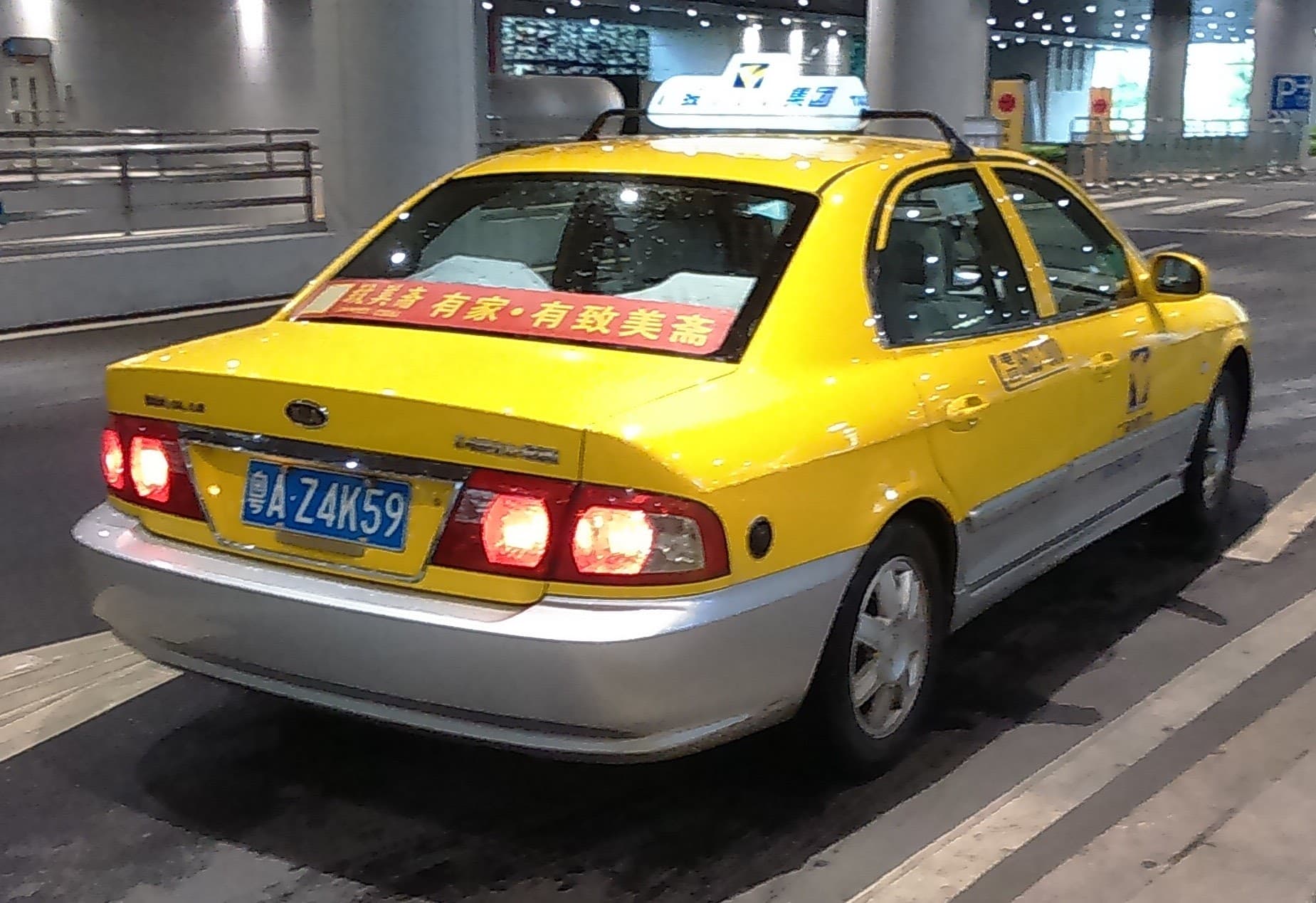
Guangzhou runs its own numbers: ¥12 for the first 3 km and ¥2.6 per km, under a joint notice of the development-and-reform commission and the transport bureau. A fare that felt normal in Beijing or Shanghai is not a benchmark for this car.
Photograph by User3204, CC BY-SA 4.0 — source and licence
Official rules · read August 12, 2026
Two official Guangzhou pages: the joint price-authority-and-transport-bureau cruising-taxi fare notice (穗发改规字〔2024〕9号), and the Transport Bureau's own listed contact. Each row states what it means for you, the figure verbatim, and where in the rule to check it.
| What it means for you | What the rule states | Where in the rule |
|---|---|---|
| The meter is fixed by rule: ¥12 for the first 3 km, then ¥2.6 per km | Guangzhou's standard sets the flag-down at ¥12 covering the first 3 km — the boarding price already includes mileage, so it is “¥12 for the first 3 km”, not “¥12 flat” — and a base rate of ¥2.6 per km beyond it. The driver does not choose this, and the numbers differ from Beijing (¥13 / ¥2.3 per km) and Shanghai (¥14 / ¥2.7 per km), which is exactly why this is a Guangzhou-specific rule rather than a national one. | 一、(一)基准运价 1 起步 / 2 续租 |
| A stuck taxi keeps billing — the ¥44/hour low-speed rule, not the driver cheating | When the taxi's operating speed drops below 10 km/h, the meter bills a waiting fee at a base ¥44 per hour. This is why a Guangzhou taxi crawling in traffic still climbs, and it is the fact most likely to read as overcharging to a first-timer — it is the tariff, applied by speed. | 一、(一)基准运价 3 候时费 |
| The meter is a government-guided price that can float by time of day | Guangzhou moved cruising-taxi fares from a government-set price to a government-guided one on a “base fare ± float band” model. The flag-down, per-km and waiting charges are the base rates that may float, so the headline numbers are a base that can legitimately move within the bands below. | 一、建立运价浮动机制(管理方式) |
| The float bands: up to +10% at peak in the first phase, as much as −30% off-peak | In the first phase an operator may choose 0% or +10% at peak (daily 07:00–10:00 and 16:00–21:00) and 0%, −10%, −20% or −30% off-peak (daily 10:00–16:00); a later phase widens the peak choice to 0%, 10%, 20% or 30%. So a legitimate fare can sit up to 10% above the base at peak or well below it off-peak — chosen per operator per band, not improvised by the driver. | 一、(二)浮动幅度 |
| A deadhead (empty-return) surcharge applies on long trips — and does NOT float | On the 15-to-25 km portion of a trip the meter adds 20% of the per-km base rate, and beyond 25 km it adds 50%. This is the empty-return charge on a long airport or cross-district run — a legitimate add-on set by rule, and it is excluded from the float band above. | 一、(四)返空费 |
| A ride between 23:00 and 05:00 is billed 30% more — and this too does NOT float | Between 23:00 and 05:00 the meter adds 30% of the per-km base rate (the same +30% night level as Shanghai). That is the surcharge a late-night flight actually pays, so a higher after-midnight fare is a rule and not the driver improvising a night price; like the deadhead charge it is excluded from the float band. | 一、(四)夜间服务费 |
| A Spring Festival arrival pays a stated ¥10 per-trip add-on | During the Spring Festival holiday a ¥10 per-trip surcharge applies, with the exact holiday dates set by the State Council each year. It is a legitimate line on the fare, not padding added because you are a foreigner, and it does not float. | 二、优化运价结构(春节附加费) |
| The exact float an operator applies can differ between central and outer districts | The float is implemented under the city transport bureau in the six central districts (Baiyun, Tianhe, Huangpu, Liwan, Yuexiu, Haizhu) and under each district's own transport bureau in the sub-centre and outer districts (Huadu, Zengcheng, Conghua, Panyu, Nansha). So the base numbers hold city-wide, but which float band an operator has chosen can vary by district — the administrative scope the notice itself draws. | 一、(三)适用边界 |
Read off: Guangzhou Municipal Development and Reform Commission (广州市发展和改革委员会), the price authority, jointly with the Guangzhou Municipal Transport Bureau (广州市交通运输局) — 关于优化调整巡游出租汽车运价的通知 (Joint notice optimising and adjusting Guangzhou cruising-taxi fares) (穗发改规字〔2024〕9号, signed 2024-10-24, in force from 2024-11-30 for 5 years; read August 12, 2026)
| What it means for you | What the rule states | Where in the rule |
|---|---|---|
| A taxi refusal or overcharge has an official Guangzhou channel: 020-12345 | On its own homepage footer the Guangzhou Transport Bureau lists its contact as 020-12345 — 12345 is the Guangzhou 政务服务便民 (citizen-service) hotline, dialled with the 020 Guangzhou area code. So a visitor with a fare dispute, refusal, or lost bag has a concrete official number named by the transport authority itself. | 官网联系方式 |
| Only the number written on the page is carried — no hours or extra usage is claimed | This layer publishes only 020-12345, the number written verbatim on the official page. The national 12328 交通运输服务监督电话 was not read off an official Guangzhou page this pass, so it is not asserted here, and the page states no opening hours, no 24-hour promise, and no cross-province dialling prefix — so none is claimed. | 官网联系方式 · 供述边界 |
Read off: Guangzhou Municipal Transport Bureau (广州市交通运输局) — 官网联系方式 (Official site contact) (contact listed in the homepage footer (网站标识码 4401000029); read August 12, 2026)
These are Guangzhou's own regulated figures, read off two official pages: the joint 发改委 + 交通运输局 cruising-taxi fare notice (穗发改规字〔2024〕9号, in force 2024-11-30) and the Guangzhou Transport Bureau's own homepage contact. They hold inside the Guangzhou administrative area only. The ¥12 / ¥2.6-per-km meter is a government-guided base that floats within the stated bands, and which band an operator applies can differ between the six central districts and the outer districts. The deadhead, night, and Spring Festival surcharges are excluded from that float. This page does NOT quote a Guangzhou metro / 轨道交通 fare: no official price-authority pricing page could be opened this pass (the 发改委 site returned connection failures and the 规范性文件库 does not hold the metro fare notice), so — per the red line — not even the qualitative “distance-segmented” fact is published, and no aggregator number is borrowed. Only 020-12345 is asserted for complaints; the national 12328 was not verbatim-confirmed on a Guangzhou page. And every other Chinese city sets its own tariff and rail table — do not carry ¥12 / ¥2.6-per-km or these surcharges to Beijing, Shanghai, Shenzhen, or elsewhere.
What this page could not confirm
The taxi fare and complaint clusters above were each read off their official owner this pass. These are the things this page deliberately does not state, because the sources do not.
National layer
This page carries the numbers that hold only inside Guangzhou. What every licensed ride-hailing platform in the Chinese mainland owes a passenger — receipts, the fare shown before you ride, and how a dispute is handled — is set by national regulation, not by any one city. That sits, article by article, on the national ride-hailing page.
Read the national ride-hailing regulationThree cities, three tariffs
| City | What only this city does | Set by |
|---|---|---|
| Beijing | In a jam the meter keeps running by time: below 12 km/h it bills 2 km of rate every 5 minutes at peak, 1 km off-peak. | Beijing Municipal Commission of Transport fare standard |
| Shanghai | Touran-type and Roewe Ei5 electric cabs start at ¥16 for the same first 3 km — a regulated car-type difference, not overcharging. | Shanghai Municipal Commission of Transport standard, guided-price band 沪交道运〔2021〕1119号 |
| Guangzhou | Low speed is billed by the hour rather than as added distance: below 10 km/h the meter charges a base ¥44 per hour. | 穗发改规字〔2024〕9号 (development-and-reform commission + transport bureau) |
Next move
Read enough to make the decision smaller, then open the checklist, search a specific question, choose a setup tool, or share the page with the person planning with you.
Use the checklist when the question has shifted from research to preparation.
Search by the actual problem: Alipay, eSIM, transit visa, first transfer, vegetarian food, or a city name.
Open recommendations when the task is clear enough for a short list to be useful.