I need the next step
Use the checklist when the question has shifted from research to preparation.
Beijing · fares by rule
In short
Beijing sets its taxi meter and metro fares by rule, not by the driver. A cab starts at ¥13 for the first 3 km, then ¥2.3 per km, with 20% added between 23:00 and 05:00; the ordinary metro runs ¥3 to ¥6 by distance. If a fare looks wrong, call 12328 for service or 12345 for price.
Street-taxi guideApplies to
Visitors taking cruising (street or ranked) taxis and the ordinary Beijing subway inside the Beijing administrative area.
Check before you rely on it
These are Beijing-only regulated figures. Day-rate charters and trips leaving Beijing are market-priced, the airport-express lines carry their own fares, and every other Chinese city sets its own tariff — so do not carry these numbers elsewhere.
The point of a metered city is that you can check the driver's number against the rule. Below is the Beijing meter, the metro distance table, and the two city lines to call — each with the official page it was read from.
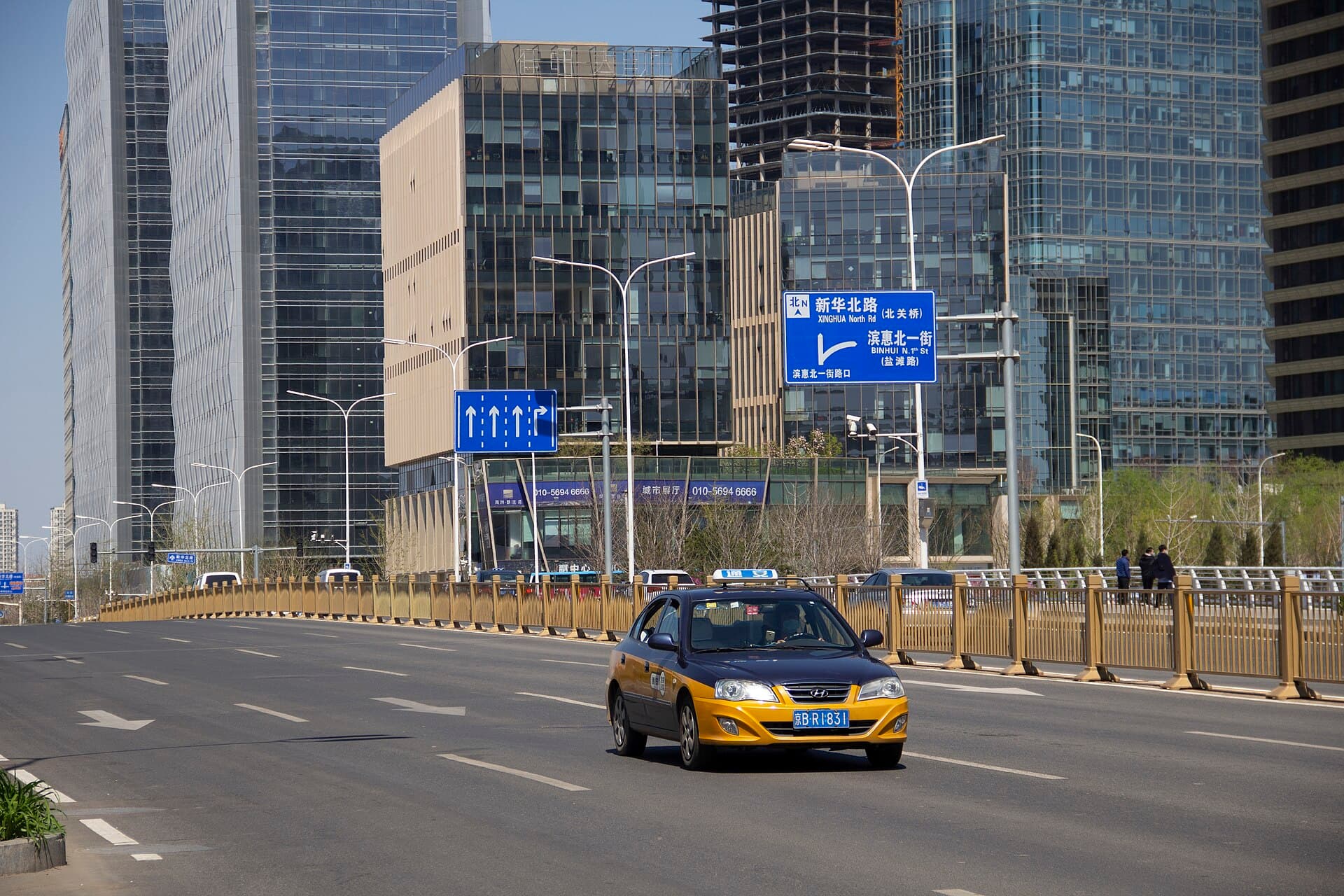
The meter in a car like this one is fixed by the city transport commission, not by the driver: ¥13 for the first 3 km, then ¥2.3 per km. Knowing that is what turns a running total into something you can check.
Photograph by 維基小霸王, CC BY-SA 4.0 — source and licence
Official rules · read August 2, 2026
Three official Beijing pages: the municipal taxi fare standard, the price authority's metro table, and the Transport Commission's complaint lines. Each row states what it means for you, the figure verbatim, and where in the rule to check it.
| What it means for you | What the rule states | Where in the rule |
|---|---|---|
| The meter is fixed by rule: ¥13 to start, then ¥2.3 per km | Beijing's standard sets the flag-down at ¥13 for the first 3 km and a base rate of ¥2.3 per km beyond it. The driver does not choose this, so you can sanity-check the running total instead of guessing whether the fare is fair. | Clause (一) |
| A stuck taxi keeps billing — the low-speed rule, not the driver cheating | Below 12 km/h the meter adds 2 km of the rate every 5 minutes during the peaks and 1 km every 5 minutes off-peak. This is why a taxi crawling in Beijing traffic still climbs, and it is the fact most likely to read as overcharging to a first-timer — it is the tariff, applied by speed. | Clauses (二) and (八) note 1 |
| The peak windows that trigger the higher low-speed rate | The morning peak is 07:00 (inclusive) to 09:00 (exclusive) and the evening peak is 17:00 (inclusive) to 19:00 (exclusive). Inside those windows the low-speed rule bills the higher 2 km per 5 minutes; outside them it is 1 km. | Clause (八) note 1 |
| A ride between 23:00 and 05:00 is billed 20% more — the exact late-arrival window | From 23:00 (inclusive) to 05:00 (exclusive) the base rate rises 20%. That is the surcharge a late-night flight actually pays, stated to the minute, so a higher after-midnight fare is a rule and not the driver improvising a night price. | Clause (五) |
| Past 15 km one-way, the base rate climbs 50% | On the portion of a one-way trip beyond 15 km the base rate goes up 50%. A round trip whose start and end are within 2 km of each other does not add this empty-return charge. It explains why a long cross-city or airport run is legitimately dearer. | Clause (四) |
| A shared ride is billed at 60% of the solo fare on the shared leg | On the carpooled portion of a trip, each passenger pays 60% of what the non-shared fare would have been for that stretch — so agreeing to share is a real discount, set by rule rather than by the driver. | Clause (六) |
| Booking a taxi ahead adds a small fixed fee | A reservation costs ¥6 if booked more than 4 hours ahead and ¥5 within 4 hours. It is a legitimate line on the fare, not padding added because you are a foreigner. | Clause (三) |
| ¥1 fuel per trip, and any road or bridge tolls, sit on top of the meter | A flat ¥1 fuel surcharge applies per trip, and tolls (road and bridge) are the passenger's to pay in addition to the meter. Both are proper additions a first-timer can mistake for overcharging. | Clauses (七) and (八) note 3 |
| Small gaps from your own arithmetic are expected: the meter steps and rounds | The meter measures distance in 500 m steps and time in 2.5-minute steps, and the final charge is rounded to the nearest whole yuan. A total that differs slightly from a hand calculation is the rounding rule, not padding. | Clause (八) note 2 |
| Day-rate charters and trips leaving Beijing are NOT on this meter | Charters settled by the day, and passenger trips that leave the Beijing administrative area, are market-priced rather than metered. This is exactly why the figures above are the in-Beijing cruising-taxi standard specifically — the boundary that keeps them from being over-generalised. | Clause (八) note 4 |
Read off: Beijing Municipal Commission of Transport (北京市交通委员会) — 《巡游出租汽车运价标准的规定》 (Cruising Taxi Fare-Standard Rules) (page dated 2023-03-10; read August 2, 2026)
| What it means for you | What the rule states | Where in the rule |
|---|---|---|
| The ordinary metro is distance-priced, so you can predict the fare before boarding | A single ordinary-metro ride is ¥3 up to 6 km, ¥4 for 6–12 km, ¥5 for 12–22 km, ¥6 for 22–32 km, and beyond 32 km each extra ¥1 buys another 20 km. The upper number of each band is inclusive (6, 12, 22 and 32 km each fall in the lower band), so a trip is priced from its distance rather than a flat fare. | 京发改〔2014〕2526号 (metro) |
| The transit-card discount is a monthly total, not a per-ride cut | Paying with a municipal transit card (一卡通), once your rides in one calendar month pass ¥100 the remaining rides are 20% off, past ¥150 they are 50% off, and past ¥400 the discount stops. It mostly matters to residents who commute; a short-stay visitor paying by QR code or single tickets does not reach it. | 京发改〔2014〕2526号 (card discount) |
| The airport-express lines are priced separately from the table above | The Capital Airport Express base fare is ¥26.7 and the Daxing Airport Express base fare is ¥36.5, with the operator setting actual fares no higher than that cap. These are a separate airport-line tariff, so do not extend the ¥3–¥6 distance bands to the airport express. | 京发改规〔2019〕2号 · 京发改〔2019〕1153号 |
| Surface buses run on their own, cheaper scale | A city bus or trolley is ¥2 up to 10 km, then ¥1 per additional 5 km — a different table from the metro, priced under the same 2014 document. Useful for comparing a short hop, but it is not the subway fare. | 京发改〔2014〕2526号 (surface bus) |
Read off: Beijing Municipal Commission of Development and Reform (北京市发展和改革委员会), the price authority — 公共交通价格 (Public-transport prices) (data date 2020-06-30, priced under 京发改〔2014〕2526号; read August 2, 2026)
| What it means for you | What the rule states | Where in the rule |
|---|---|---|
| A taxi refusal or overcharge goes to 12328 | On its own Q&A page the Beijing Transport Commission names 12328 as the transport-service supervision line for enquiries and complaints — the number a refused, overcharged, or lost-bag taxi complaint lands on. | Enquiry / complaint hotlines |
| A pricing dispute goes to 12345 | The same page names 12345 as the price supervision line. The split is deliberate: 12328 is for the service (a driver's conduct), 12345 is for the price — so route your call by the kind of problem rather than collapsing both into one number. | Enquiry / complaint hotlines |
Read off: Beijing Municipal Commission of Transport (北京市交通委员会) — 对道路停车有疑问时,如何进行咨询和投诉? (Transport Commission Q&A knowledge base) (page dated 2022-04-26; read August 2, 2026)
These are Beijing's own regulated figures, read off three official pages: the Beijing municipal taxi fare standard, the Beijing price authority's metro table, and the Beijing Transport Commission's complaint lines. They hold inside the Beijing administrative area only. Day-rate charters and trips leaving Beijing are market-priced, not on this meter (taxi note 4). The metro distance bands are for the ordinary subway, not the Capital or Daxing airport-express lines, which carry their own base fares. The transit-card discount is a monthly-accumulation rule for card holders, not a per-ride cut a short-stay visitor reaches. And no opening hours are asserted for 12328 or 12345, because the source page states the numbers but not their hours. Every other Chinese city sets its own taxi tariff and metro table — do not carry ¥13 / ¥2.3-per-km or the ¥3–¥6 metro bands to another city.
What this page could not confirm
The four fact clusters above were each read off their official owner this pass. These are the things this page deliberately does not state, because the sources do not.
National layer
This page carries the numbers that hold only inside Beijing. What every licensed ride-hailing platform in the Chinese mainland owes a passenger — receipts, the fare shown before you ride, and how a dispute is handled — is set by national regulation, not by any one city. That sits, article by article, on the national ride-hailing page.
Read the national ride-hailing regulationThree cities, three tariffs
| City | What only this city does | Set by |
|---|---|---|
| Beijing | In a jam the meter keeps running by time: below 12 km/h it bills 2 km of rate every 5 minutes at peak, 1 km off-peak. | Beijing Municipal Commission of Transport fare standard |
| Shanghai | Touran-type and Roewe Ei5 electric cabs start at ¥16 for the same first 3 km — a regulated car-type difference, not overcharging. | Shanghai Municipal Commission of Transport standard, guided-price band 沪交道运〔2021〕1119号 |
| Guangzhou | Low speed is billed by the hour rather than as added distance: below 10 km/h the meter charges a base ¥44 per hour. | 穗发改规字〔2024〕9号 (development-and-reform commission + transport bureau) |
Next move
Read enough to make the decision smaller, then open the checklist, search a specific question, choose a setup tool, or share the page with the person planning with you.
Use the checklist when the question has shifted from research to preparation.
Search by the actual problem: Alipay, eSIM, transit visa, first transfer, vegetarian food, or a city name.
Open recommendations when the task is clear enough for a short list to be useful.