01
Needs live checkEntry path
Confirm passport, route, stay length, first entry city, arrival card, and whether a visa-free, visa, or transit path applies.
Traveler job
Know whether the trip can legally start before buying more plans.
Food readiness
Food can be one of the reasons people come to China, not one of the things that makes the trip feel harder. This page turns dining into a practical path: what to expect, where to start, how to order, how to pay, and how to handle restrictions.
First meal plan
Start with a place that has photos, predictable hours, and visible payment options.
Use one dish, one drink, and one backup phrase before trying a harder meal.
Open the wallet, keep a card or cash fallback, and avoid improvising at checkout.
First restaurant rule
Choose the first meal for clarity, not bragging rights. Once QR ordering, payment, and spice level feel manageable, the food trip can get more adventurous.
Trip path
Use this page after phone data and payment are ready, then make the first restaurant interaction predictable before chasing harder meals.
01
Needs live checkConfirm passport, route, stay length, first entry city, arrival card, and whether a visa-free, visa, or transit path applies.
Traveler job
Know whether the trip can legally start before buying more plans.
02
Use with caveatMake maps, translation, wallet prompts, hotel details, and support contacts usable before leaving the airport.
Traveler job
Keep the phone useful when the traveler is tired, offline, or moving.
03
Use with caveatPrepare one primary wallet, one linked card, one backup card or cash path, and the first small checkout flow.
Traveler job
Complete the first snack, taxi, or restaurant payment without debugging in a queue.
04
Needs live checkChoose the first airport-to-hotel route, save the hotel address in Chinese, and keep a fallback if data or payment is slow.
Traveler job
Reach the hotel without making the airport arrival the hardest part of the trip.
05
ReadyPick one low-friction meal area or restaurant type and prepare ordering, dietary, and QR-payment fallback notes.
Traveler job
Eat something simple before chasing the perfect food plan.
06
ReadySave emergency numbers, insurer details, consular support, hotel contacts, and lost-passport backup before travel day.
Traveler job
Know who to contact if luggage, payment, health, documents, or transport fails.
07
ReadyChoose a first base and route shape only after entry, phone, payment, transfer, meal, and support basics are stable.
Traveler job
Avoid building an exciting route on top of unresolved first-day risk.
Meal readiness sequence
Food readiness is strongest when the traveler can pay, explain restrictions, and choose a forgiving first restaurant before chasing harder meals.
The first meal is easier when the wallet, card fallback, and cash backup are already familiar.
Check paymentAllergies, halal, vegetarian, and medical needs should travel as saved Chinese-language cards.
Save supportStart food discovery in a city and neighborhood where menus, transport, and hotel backup are easier.
Compare citiesFood answers
These guides route food searchers toward practical cards, payment fallback, and support paths before the first restaurant interaction.
Pick a simple first restaurant, expect QR menus and mobile payment, save dietary phrases, and treat the first meal as a practical warm-up rather than a food hunt.
Prepare a clear Chinese-language allergy or dietary card, choose a lower-risk first restaurant, avoid unclear sauces or broths, and keep hotel or local support ready for translation help.
Plan halal meals city by city, save Chinese-language dietary phrases, choose a lower-risk first meal, and verify restaurants locally instead of assuming every city works the same way.
Prepare exact Chinese dietary wording, avoid ambiguous broths or sauces, pick a simple first restaurant, and keep translation support ready because vegetarian assumptions vary by region and restaurant type.
Recognise it on the table
Not a list of famous dishes. These six were chosen because the four questions that decide whether you can eat something — pork, peanut, shellfish, chilli — land differently on each of them.
These cues are the editorial team's judgement about the standard version of each dish, not a sourced fact: no official page publishes what is in a bowl. Recipes vary by region, by restaurant and by cook. Use them to know which question to ask — the pages linked beside each dish carry the sourced wording for asking it.
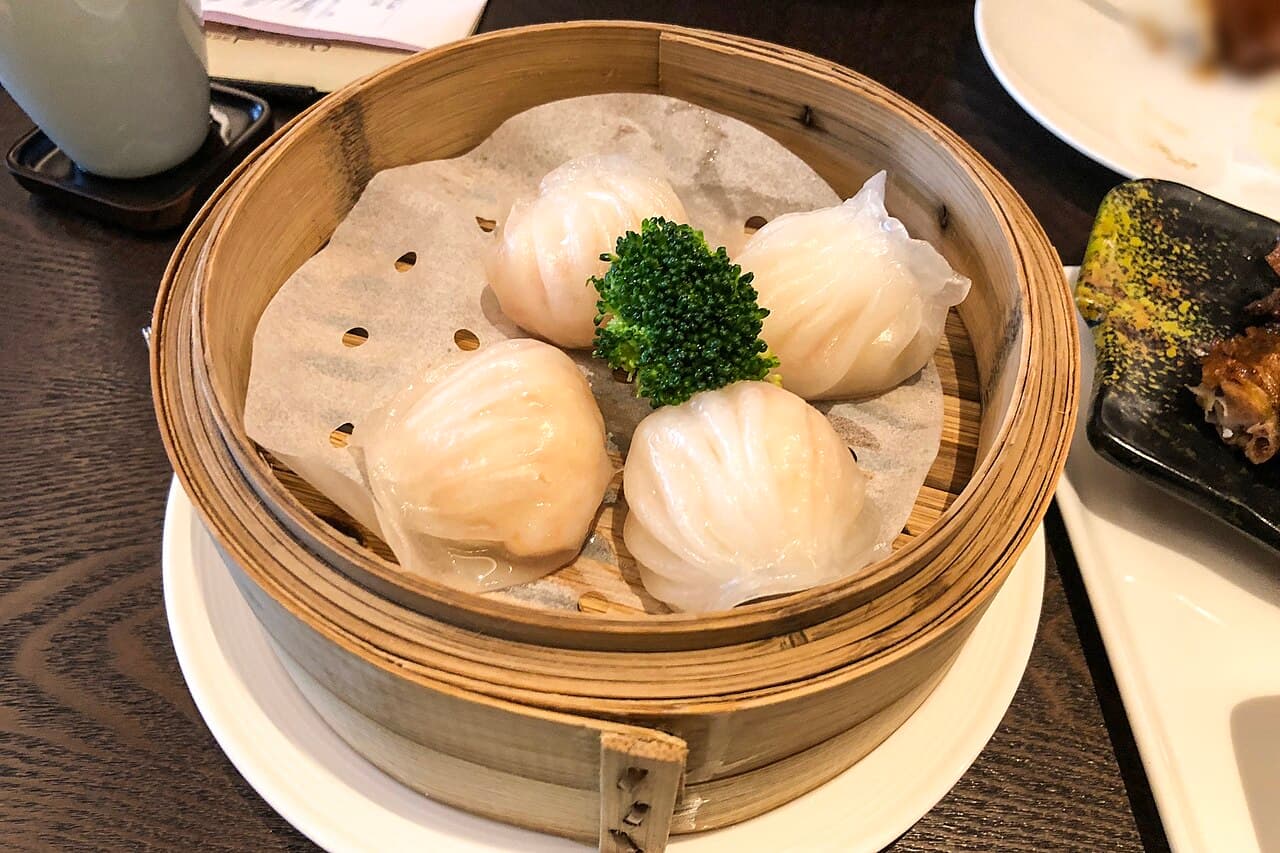
The signature Cantonese breakfast dumpling: whole shrimp wrapped in a translucent skin and steamed. The wrapper is deliberately see-through, so the shrimp is visible before you pick it up.
A shellfish allergy is the reason to learn this one on sight: at a dim sum table the steamers arrive together and the shrimp fillings are not announced. Har gow, siu mai and many rice-noodle rolls all carry shrimp, so the question is worth asking once for the whole table rather than dish by dish.
Siu mai, the yellow open-topped dumpling usually served alongside, is normally pork with shrimp on top — the two are ordered together so often that avoiding one and not the other rarely works.
Photograph by N509FZ, CC BY-SA 4.0 — source
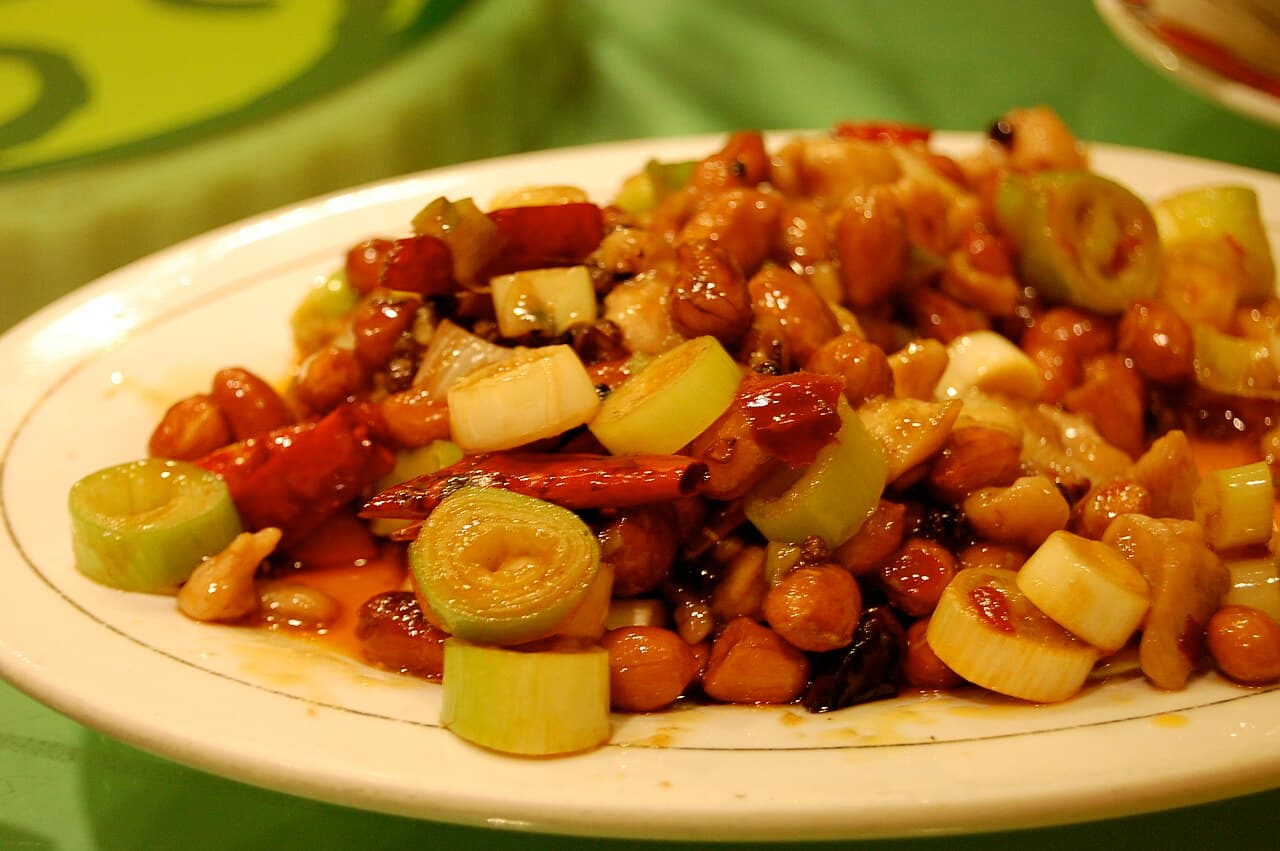
Diced chicken stir-fried with dried chillies, spring onion and peanuts. The peanuts are not a garnish you can pick around — they are cooked through the dish.
If peanuts are the problem, this is the dish to recognise on sight, because it looks mild and is not. Carry the allergy wording rather than asking in English at the table.
Photograph by Steven G. Johnson, CC BY-SA 3.0 — source
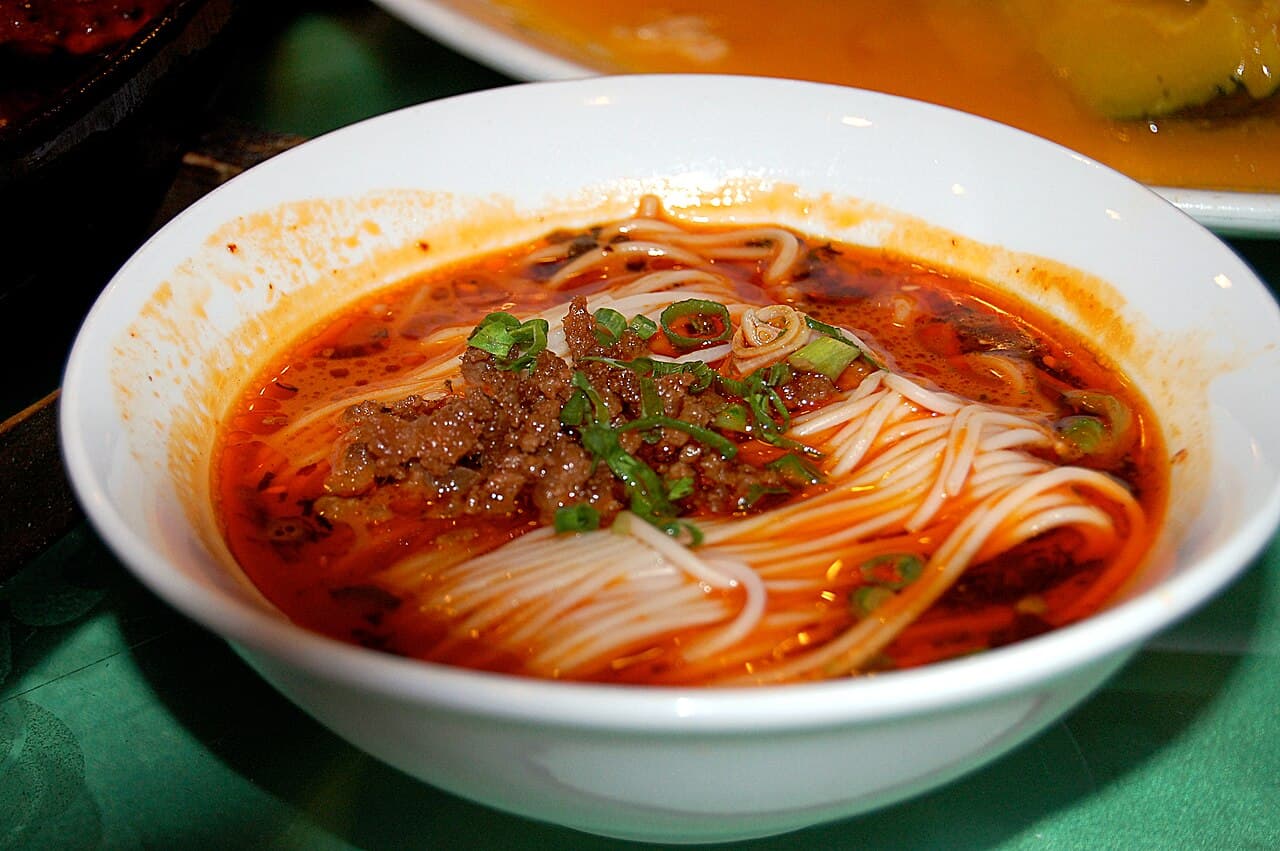
Noodles under minced meat with chilli oil, usually with sesame or peanut in the sauce. The minced meat is normally pork.
This is the one that catches people who avoid pork: the meat is minced and stirred in, so there is nothing to leave on the side. Ask before ordering, not after it arrives.
The photograph is the soupy version served in Shanghai. In Chengdu the same name usually arrives close to dry, with a thicker sesame sauce and much less liquid.
Photograph by Steven G. Johnson, CC BY-SA 3.0 — source
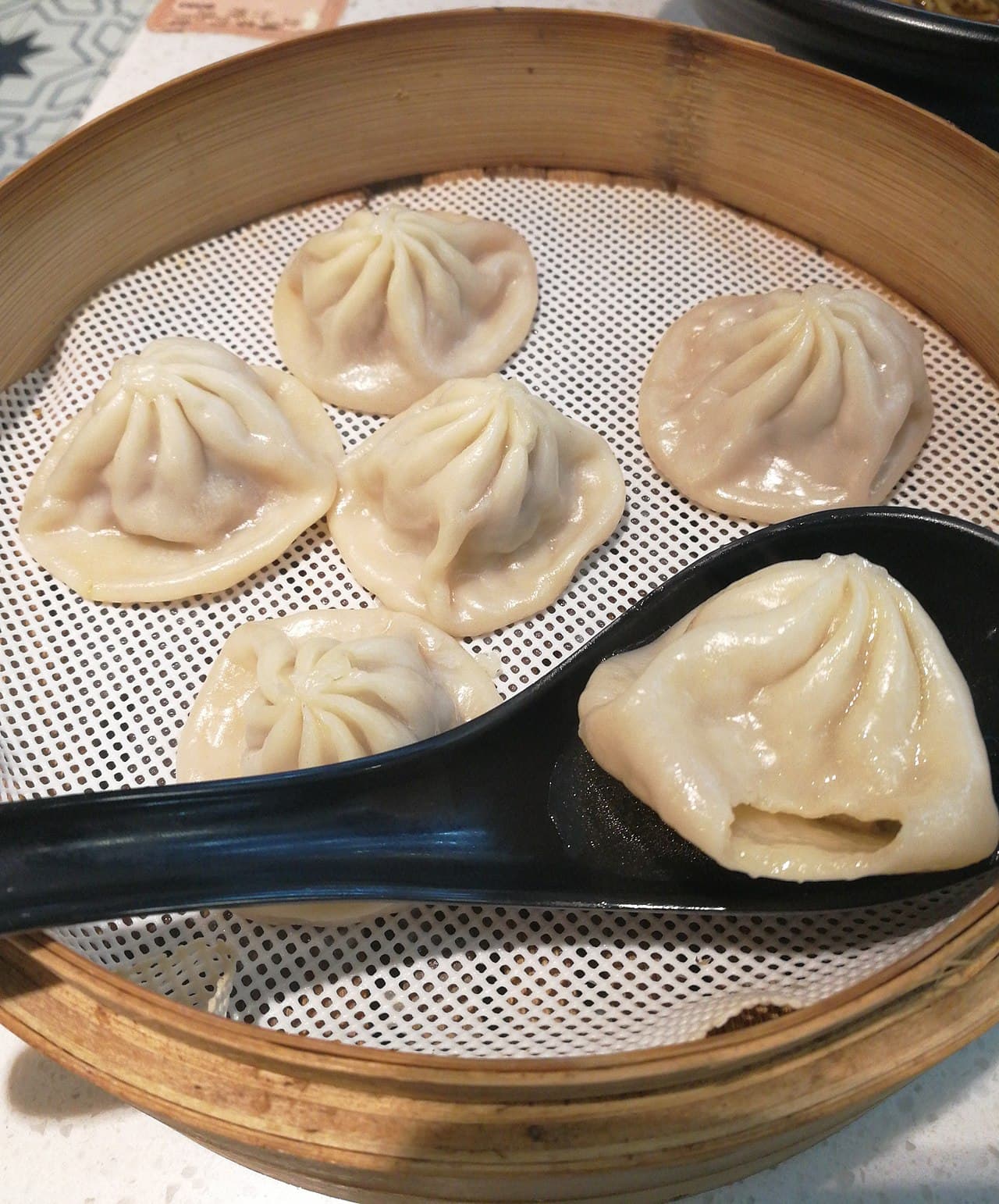
Thin-skinned steamed dumplings filled with pork and hot soup, served in a bamboo steamer.
Pork is the default filling, and the filling is sealed inside, so it cannot be inspected before biting. Bite carefully in any case: the soup inside is hot enough to burn.
Photograph by Robigasp, CC BY-SA 4.0 — source

Shredded braised meat packed into a split flatbread — the version most often described in English as a Chinese hamburger.
The default filling is pork, but the beef version is common in Muslim-quarter streets and is a different stall, not a different order at the same stall. If pork is the issue, choose the stall first.
Photograph by P. Xie, CC BY-SA 3.0 — source
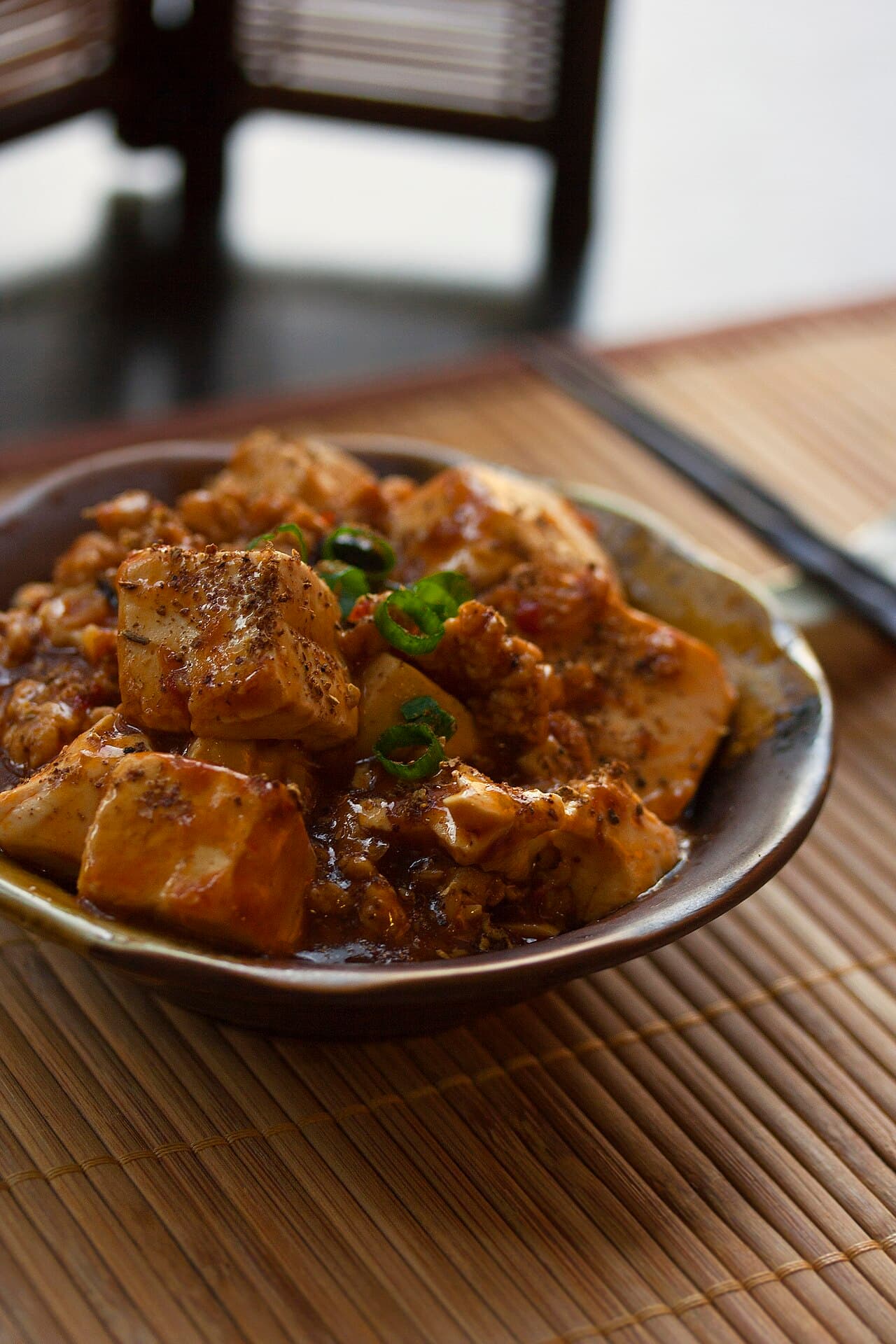
Soft tofu in a chilli-and-Sichuan-pepper sauce, normally with minced beef or pork stirred through it.
Tofu on the menu does not make this a vegetarian dish — the minced meat is part of the standard recipe. The numbing feeling from the Sichuan pepper is normal, not an allergic reaction.
The photograph shows firmer, larger tofu cubes than the very soft version usual in Sichuan.
Photograph by Archon6812, CC BY-SA 3.0 — source
Dish cues reviewed
QR menu guide
The food problem is often an app problem: scan, translate, choose, confirm, pay, and ask staff when the mini-program stalls.
Use this before the first restaurant: translation, safe dishes, spice, allergy phrases, mini-program fallback, and payment.
Open QR menu guideUnderstand how payment, food, metro, and attraction QR codes differ before scanning under pressure.
Open QR guideLast checked:
Use official health guidance, restaurant judgment, hotel support, and translated dietary cards for safety-critical food decisions. This page helps plan the first meal, but it cannot verify every ingredient, kitchen, or allergy risk.
What may change
Fallback action
For allergies, halal, vegetarian, or medical restrictions, use a written Chinese card and choose a lower-risk first restaurant with staff support.
First meal flow
The goal is not to remove discovery. It is to remove avoidable embarrassment, payment failure, and menu confusion during the first meal.
Check whether the restaurant has photos, an English menu, mall location, or recent reviews. For the first meal, choose clarity over fame.
Look for a QR menu, paper menu, or staff ordering. Open translation before scanning if the menu is only Chinese.
Order one safe staple, one vegetable, one protein, and one local signature. Shared dishes are normal.
Try Alipay or WeChat Pay first, but keep a card and some cash as fallback. Small vendors may be less predictable.
Dining habits
These are the practical patterns that turn a meal from confusing to enjoyable.
Western travelers used to individual mains
Many meals are shared from the middle of the table. Visitors should expect to order several dishes for the table instead of one plate per person.
Traveler move
Ask for one vegetable, one protein, one staple, and one regional dish when you are unsure.
Travelers with low spice tolerance or children
Sichuan, Chongqing, Hunan, and some Yunnan meals can be much spicier than Shanghai, Hangzhou, Suzhou, or Cantonese food.
Traveler move
Learn a mild-spice phrase and keep one plain carb or vegetable dish on the table.
Visitors anxious about first restaurant interactions
Restaurants may expect guests to scan a table QR code, order in an app-like menu, and pay digitally before or after the meal.
Traveler move
Keep translation, WeChat/Alipay, and a fallback card ready before entering a busy restaurant.
Travelers who want real daily-life moments without complex planning
Hotel breakfast is easy, but local breakfast culture is a strong browse layer: soy milk, buns, noodles, congee, rice rolls, and regional snacks.
Traveler move
Start with one nearby breakfast street or mall basement food court before chasing famous restaurants.
Vegetarians, Muslim travelers, allergy-sensitive travelers
Vegetarian, halal, allergy, and no-pork needs should be written clearly because staff may not interpret English dietary labels the same way.
Traveler move
Carry a translated dietary card and use hotel staff to sanity-check important meals.
Source-reviewed rules
Food research found useful guidance from reputable travel sources. This section rewrites the useful facts into original traveler moves instead of copying guidebook prose.
Current dining evidence supports explaining China by regional flavor: Sichuan and Chongqing skew spicy, Cantonese food is often gentler, and Shanghai/Hangzhou/Suzhou are safer soft-landing food bases.
Traveler move
Do not ask whether Chinese food is spicy. Ask whether this city, dish, and sauce are spicy.
Breakfast is the easiest first local meal: soy milk, buns, congee, noodles, rice rolls, and hotel breakfast all work as low-risk fallbacks.
Traveler move
Use breakfast for local discovery because it is cheap, practical, and easier to recover from than a failed late-night meal.
The food-safety review surfaced practical street-food cautions around undercooked barbecue, seafood far from the coast, and stalls without visible hygiene practices.
Traveler move
Start with busy cooked-to-order stalls and avoid testing many unfamiliar street foods in one sitting.
Vegetarian, halal, no-pork, and allergy guidance is useful but requires clear Chinese-language backup because sauces, broth, and cooking oil can hide ingredients.
Traveler move
Carry a translated card, then use hotel staff or a trusted restaurant to verify the first high-stakes meal.
City food notes
This table uses recent source checks: commercial guide prose and placeholders were removed, official source links are retained, and dish notes are rewritten as practical traveler guidance.
3 official anchors
Typical Beijing breakfast includes soybean milk (豆浆) with deep-fried dough sticks (油条), steamed buns (包子), or congee. Douzhi is a distinctive local breakfast but challenging for most visitors. Hotels serve 7-9:30am.
5 official anchors
Shanghai breakfast includes xiaolongbao, scallion oil noodles (葱油拌面), soybean milk with youtiao, and rice congee. Many bakeries sell fresh bread and pastries. Hotels serve 7-9:30am.
1 official anchors
Guangzhou is famous for yum cha (饮茶) — leisurely morning tea with dim sum, especially on weekends. Locals spend 1-2 hours at restaurants ordering multiple small dishes. Common breakfast also includes congee, rice noodle rolls, and wonton noodles.
2 official anchors
Shenzhen breakfast follows Cantonese tradition: dim sum, congee, rice noodle rolls. As a migrant city, you'll also find breakfast styles from all over China. Many restaurants open early for morning tea.
2 official anchors
Chengdu breakfast includes red oil noodles (红油面), douhua (tofu pudding with savory or sweet toppings), and shaomai. Locals enjoy a relaxed morning pace with tea houses.
1 official anchors
Chongqing breakfast centers on xiao mian (spicy noodles) — the city's signature morning dish. Also popular: haochi (assorted snacks), wontons, and steamed buns.
1 official anchors
Xi'an breakfast is hearty and wheat-based: youcha mahua (savory grain porridge with fried dough twists), paomo, and noodles. The Muslim Quarter comes alive at breakfast time.
1 official anchors
Hangzhou breakfast includes congee, xiaolongbao, and noodles. The city is known for its tea culture — many locals start the day with a cup of Longjing tea.
1 official anchors
Nanjing breakfast features duck blood vermicelli soup, soup dumplings, and fried dumplings. The city has a strong duck culture — duck appears in many forms throughout the day.
Food cities
A first-time visitor needs the right first food environment before chasing every famous dish.
Soft landing
Good for first meals because international hotels, malls, bilingual menus, and delivery options are easier to find.
Use Shanghai for the first QR menu, first mobile payment, and first local breakfast test.
Food-first comfort
Excellent for travelers who want the food experience to lead the trip, with strong cafe and teahouse culture between meals.
Ask for mild spice first, then scale up after one safe meal.
Dim sum and Cantonese rhythm
A calmer food path for many Southeast Asian and Western visitors because Cantonese food is broad, breakfast-friendly, and less spice-heavy.
Start with morning dim sum or a restaurant inside a major mall before exploring older neighborhoods.
History plus Muslim Quarter food
Good when the traveler wants food attached to history, walking streets, and a clear evening browse zone.
Keep cash and translation ready in busy snack areas, especially when stalls are crowded.
Food readiness
Use food comfort to choose the right first city, not just to collect dish names.
Strong first-food city
Cantonese breakfast, dim sum, rice rolls, congee, and roast meats create a lower-spice first food path.
Great, but spicy
Excellent for hotpot and night food, but travelers need a mild-spice plan and non-spicy backup dishes.
Useful Yunnan base
Good for rice noodles, mushrooms, and gentler first Yunnan meals before Dali or Lijiang routes.
Seafood caution
Seafood is part of the city identity, but visitors should be careful with freshness, shellfish allergies, and alcohol-heavy meals.
Dietary backup
A traveler with allergies, vegetarian needs, halal requirements, or no-pork rules should not rely on improvised English at a busy counter. The safe version is a translated card, hotel support, and a lower-risk restaurant for the first meal.
I do not eat meat, seafood, or meat broth.
Vegetarian dishes can still include oyster sauce, lard, or meat stock. Ask clearly and keep a written card.
I need halal food and do not eat pork.
Look for Muslim restaurants, Lanzhou noodle shops, and hotel help when the city is unfamiliar.
I have a serious allergy to this ingredient.
Treat allergy communication as safety-critical. Use a translated allergy card and avoid complex sauces when unsure.
Meal payment practice
Next step
QR menus, table ordering, small shops, and food streets all become easier when the traveler has already tested mobile payment and has a fallback.
Next move
Read enough to make the decision smaller, then open the checklist, search a specific question, choose a setup tool, or share the page with the person planning with you.
Use the checklist when the question has shifted from research to preparation.
Search by the actual problem: Alipay, eSIM, transit visa, first transfer, vegetarian food, or a city name.
Open recommendations when the task is clear enough for a short list to be useful.