Wallet first, gate second
The QR route needs a funded wallet. The portal states Alipay accepts both Chinese and international bank cards, but a busy gate is the wrong place to find out.
Metro QR
By TravelerLocal editorial teamPublished Information checked
In short
Use the QR code once the wallet is set up and tested, and know the rest of the ladder before you reach a gate. Beijing's own tourism portal lists four routes in order: the metro QR code inside Alipay, a ticket vending machine in English mode that takes WeChat, Alipay, credit cards or cash, a staffed counter, and a Beijing Pass smart card sold at the international airport terminals.
Plan first transferApplies to
Foreign visitors using Alipay or WeChat transport codes, local metro apps, single tickets, station counters, airport rail, city subway systems, and luggage-heavy transfers.
Check before you rely on it
Four layers, four dates, four different publishers. The four ticketing routes below were read off the Beijing municipal tourism portal on July 25, 2026, and that page states its own content as current to December 2023. The fare tables are newer and separate: read 2026-08-22 off the Beijing and Shanghai municipal governments’ own English portals. Those two portals publish Beijing and Shanghai; Chongqing and Xi’an are named below as not sourced rather than guessed at. A third layer, read September 19, 2026, is what two metro operators’ own ticketing rules say about a foreign-issued bank card at their gates: Shenzhen and Chengdu stated, Guangzhou marked not stated because its operator’s page could not be opened. The newest layer, read October 6, 2026, is what the QR ride code itself pays: Shenzhen’s and Guangzhou’s transport bureaus write opposite rules about it, Shenzhen’s distance bands are published there, and Hangzhou is shown as a city nothing official was opened for rather than left out.
Metro QR codes can make city movement easy, but first-time visitors need the wallet set up, a machine they can read, and a counter behind that.
Decision guide
The QR code is the top rung, not the only one. Every rung below it works without your phone.
The QR route needs a funded wallet. The portal states Alipay accepts both Chinese and international bank cards, but a busy gate is the wrong place to find out.
Beijing's vending machines have an English mode and take WeChat, Alipay, credit cards or cash. This is the rung most visitors skip and the one that usually works.
The Beijing Pass smart card is sold at the international airport terminals and is described as designed for foreign visitors.
This gate ladder is Beijing's, published by Beijing. Fares are a separate layer: Beijing and Shanghai are published below from their own city governments' pages, and the cities that could not be sourced are named rather than assumed to match.
Saveable checklist
In short
The four ticketing routes, what to do when the code fails, foreign cards at the machine and at the gate, what a ride code pays in Shenzhen and Guangzhou, fares, exit time limits, and security.
In Beijing the municipal tourism portal names a metro QR code inside Alipay as one of four ticketing routes, alongside English-mode vending machines, staffed counters, and a Beijing Pass smart card sold at the international airport terminals. Set the wallet up before you need the gate.
Step down the ladder rather than standing at the gate. Beijing's portal describes vending machines with an English mode that take WeChat, Alipay, credit cards or cash, and staffed counters behind them. Move aside first; the queue behind you cannot go around.
Beijing's portal states the ticket vending machines take credit cards or cash as well as WeChat and Alipay, and that Alipay accepts both Chinese and international bank cards. Machine acceptance is the more reliable of the two to lean on for a first ride.
Both price by distance, and both city governments publish the bands on their own English portals. Beijing: CNY 3 up to 6 km, CNY 4 for 6–12 km, CNY 5 for 12–22 km, CNY 6 for 22–32 km, then CNY 1 more for every additional 20 km, with no fare cap; the Capital Airport Express sits outside that ladder at a flat CNY 25. Shanghai: CNY 3 up to 6 km, then CNY 1 more per 10 km; the Airport Link Line starts at CNY 4 and runs CNY 26 end to end, and the maglev is CNY 50 one way. Read on 22 August 2026. Every Chinese city sets its own fare, so do not carry these numbers to a third city.
Yes, two of them, and Shanghai's municipal portal publishes both. Tap or scan the same card or transport QR for a bus and then enter a metro station within 120 minutes, and CNY 1 comes off the metro fare. Spend more than CNY 70 on metro rides on the same card or code inside one calendar month and every later ride that month is 10% off. There are also day passes — CNY 18 for one day, CNY 45 for three — but they exclude the maglev and any suburban railway line opened in or after 2024.
The plain maglev ticket is CNY 50 one way and CNY 80 return. The Maglev and Metro Pass costs CNY 55 single or CNY 85 return and bundles a full one-day metro pass with the maglev ride — so the day of metro adds CNY 5 to a one-way maglev ticket. Note the ordinary one-day and three-day metro passes do not include the maglev, and the transport QR code works on the metro, buses, the Airport Link Line, the maglev and ferries but explicitly not on the Jinshan Rail Line.
Shenzhen Metro's own ticket rules list international bank cards (国际银行卡) as a ride medium, so yes as a rule — but on the operator's terms. The tap is a pre-authorised transaction, and the card must hold at least the network's highest single fare for the business carriage; if that pre-auth fails for insufficient balance or limit, the system restricts the card's ride function rather than charging you later (车票使用规则 11). The rules do not say which card schemes qualify or which gates have the readers on, so a travel-blocked or low-limit card is the thing to test on a quiet gate, not at a peak-hour interchange. Read off szmc.net on 19 September 2026.
Chengdu's operator notice (票务须知, 2025-07-27) covers bank cards issued inside or outside the mainland (境内(外)发行的银行卡) as a way to ride. If your tap-in or tap-out is missing, you have until the 7th day after the trip to complete the record at a station self-service ticket machine or customer service centre; from the 8th day the network-maximum single fare is deducted for that record (四.9). So Chengdu's failure mode is a repair window then a maximum charge, while Shenzhen's is a pre-auth that blocks the card — the same 'foreign card at the gate' question has a different answer city by city, and that is sourced from the two operators, not a hedge.
Yes, and Shenzhen's transport bureau says so in writing. The 5% discount (票价9.5折) is tied to a 深圳通 card or a national transit card issued in Shenzhen, and the bureau's own fare-policy page names four things that get no discount at all: the Shenzhen Metro ride code, the Shenzhen Tong ride code, a financial IC (bank) card, and another city's transit card (优惠政策·1 and ·3). So scanning is the convenient way and the full-price way at once. The full fare itself is a four-band distance ladder published by the same bureau: CNY 2 for the first 4 km, then each further CNY 1 buys 4 km up to 12 km, 6 km from 12 to 24 km, and 8 km beyond that. Read on 6 October 2026.
At the counter machines in eight stations, and at a staffed window anywhere. The transport bureau's 2024-04-28 notice says smart POS machines that take foreign cards were fitted at eight stations covering the airport, the main rail stations and the border crossings — Luohu, Huanggang Port, Wenjin, Airport, Futian, Gangxia North, Shenzhenbei and Buji — accepting Visa, Mastercard, Discover, American Express, Diners Club and JCB, plus a digital-RMB hard wallet. Separately, the bureau states that staffed customer-service windows at every station on the network take cash. The alternative is the ride code: bind the overseas card in WeChat, open the Shenzhen Metro mini-program, accept the service agreement and enable password-free payment, after which the fare is deducted when you exit rather than when you enter. None of that says your card taps directly on a gate network-wide, and the notice does not claim it.
No — it is the reverse, which is the clearest proof that this question has a city-by-city answer. Guangzhou's transport bureau wrote a universality principle into 穗交运规字〔2021〕7号: fare discounts apply to all passengers and must be obtainable through a Yang Cheng Tong physical card, an NFC virtual card or a ride code alike, with no discriminatory conditions (三(二)). Shenzhen names the ride code as excluded; Guangzhou requires it to be included. Two caveats kept in the open: that Guangzhou document lapsed on 2026-08-11 under its own five-year clause and no successor was found on the city's register when we read it on 2026-10-06, and Guangzhou still publishes no metro fare table anywhere official, because the measures hand the drafting of the discount scheme to the operator rather than the bureau.
It depends on the operator, and two publish the number. Shenzhen: exit within 210 minutes of tapping in (车票使用规则 3). Chengdu: exit within four hours, or the network's highest single fare is added at the exit station (票务须知 四.2). Beijing's fare page calls its ladder time-limited but prints no hours, so none are given here. Both cities also require the same card or the same app's code in and out — no swapping phones or apps mid-trip.
Expect bag checks and screening, and add time with luggage or at rush hour. No city metro operator publishes an English restricted-articles list, so the published railway limits should not be assumed to apply at a subway gate.
At a large hub, yes, as a policy target. The State Council payment-convenience Opinions (国办发〔2024〕10号, 2024) make it mandatory (必须) for scale-above transit hubs to be equipped to accept mobile payment, bank card and cash, and to guarantee your right to choose the method (clause 二(四)). So a failed QR entitles you to a card or cash route at a major metro hub, not a dead end. The policy sets no fare number, and a small suburban station is not the same as a major hub — carry some cash regardless.
Because the national payment rules are locality-led by design. The same 2024 Opinions repeatedly assign the rollout to each local government (各地方政府) drawing up its own lists (clause 二(一)), which is why each Chinese city runs its own metro ride code and sets its own fare, and why no honest page can quote one national metro QR or one national price. It is the sourced reason, not this site dodging the number.
12328, the Ministry of Transport's single nationwide (一号通) transport service-supervision line for complaints (投诉举报) and enquiries (咨询服务). Honest scope note: the plan we opened covers road transport, highways and waterways, and metro (urban rail) is explicitly brought under 12328 by the later 2023 管理办法 we could not open this pass. Dial 12328 directly within a city, or prefix the destination city's area code from another province.
Decide when metro is right for the first transfer and when taxi/pickup is calmer.
Open guideUnderstand payment, menu, metro, and attraction QR flows together.
Open guidePrepare wallet and card fallback before relying on transport QR.
Open guideVisit Beijing, the Beijing municipal tourism portal · read July 25, 2026
Work down the table. Each rung needs less of your phone than the one above it.
| Route | What it needs | Use it when |
|---|---|---|
| Metro QR code inside Alipay | A working Alipay account with a funded payment method. The portal states Alipay accepts both Chinese and international bank cards. | Your wallet is already set up and tested. This is the fastest gate, and the worst place to test a new account for the first time. |
| Ticket vending machine in English mode | The machines have an English mode and take WeChat, Alipay, credit cards or cash. | The QR will not load, the phone is flat, or you are carrying luggage and do not want to hold up a gate. |
| Staffed counter | Cash, a card, and the name of your destination station. | The machine rejects your card, or you need someone to point at the right line. |
| Beijing Pass smart card | Buy it at the international airport terminals. The portal describes it as designed for foreign visitors. | You land in Beijing before your wallet apps are working and want a card in hand on day one. |
The portal gives operating hours as roughly 05:00 to 23:00, varying by line. Confirm the last train on the specific line before planning a late return.
Open source: Beijing municipal tourism portal, subway pagePage read
Superseded on 2026-08-22, kept here rather than deleted: this note used to say the only reachable official English page was current to December 2023, so no fare bands were printed. That is no longer the reachable set — the Beijing municipal government's own English portal publishes the bands on a page stamped 2025-04-23, and Shanghai's carries a stamp of June 30, 2026. Both are now printed in the fare tables above. What the tourism portal below still supplies is the ticketing ladder, not the fares, and its December 2023 currency note applies to that ladder only.
The gate ladder is Beijing's, read off Beijing's own tourism portal, and it stays scoped to Beijing: no other city's ticketing flow is described here. Fares are a separate, newer layer and reach two cities — Beijing and Shanghai — from those city governments' own English portals. Which cities are missing from that layer, and why each one is missing, is stated next to the fare tables rather than left as a silence.
On security: These limits are China Railway's, for trains and railway stations. No city metro operator publishes an equivalent list in English, so do not assume the same millilitres apply at a subway gate.
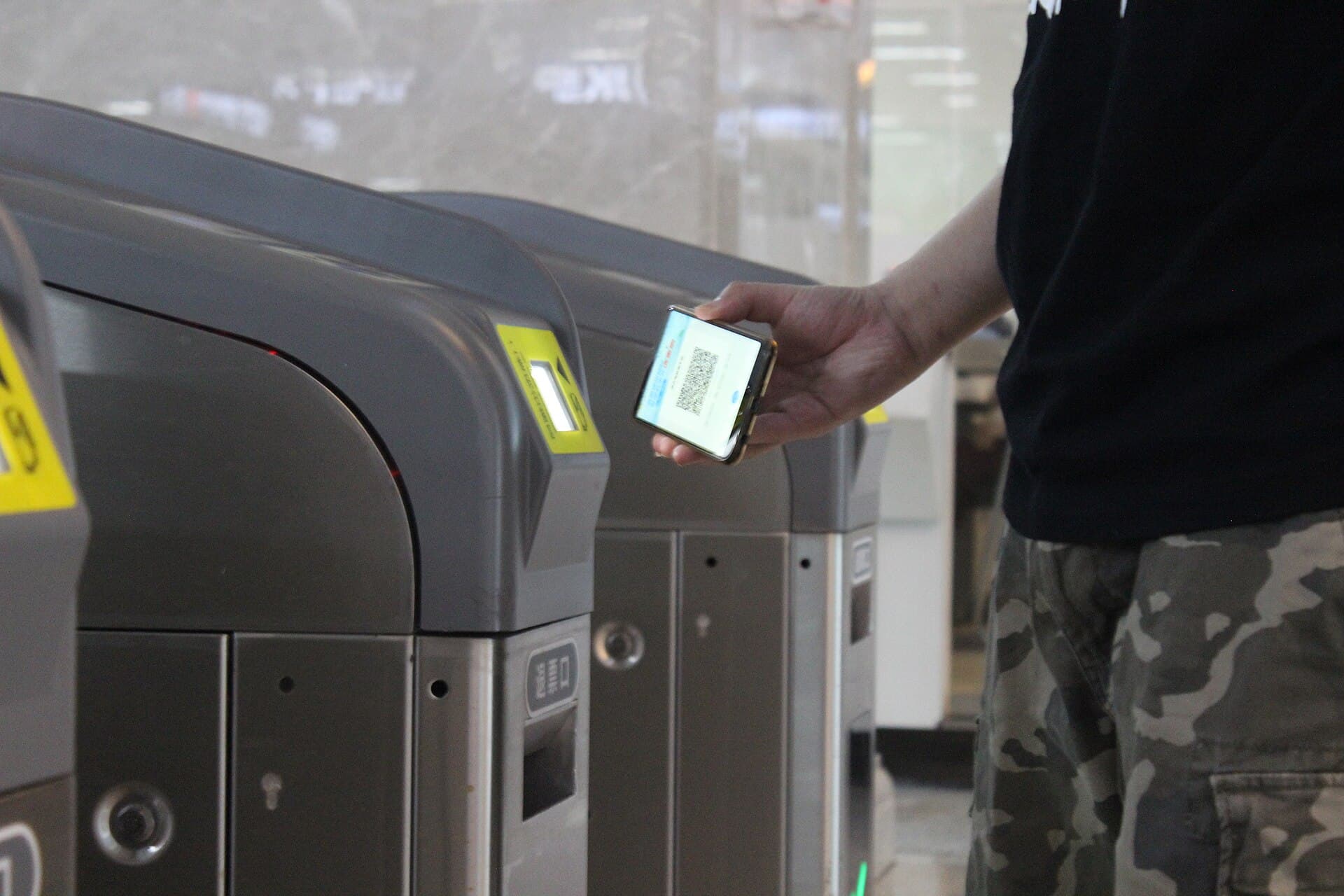
The top rung of the ladder above, at the gate. Scanning works when the wallet is already funded and tested; the rungs below it — the English-mode machine, the staffed counter — are what you fall back to when it does not, and they need nothing from your phone.
Photograph by Painjet, CC BY-SA 4.0 — source and licence
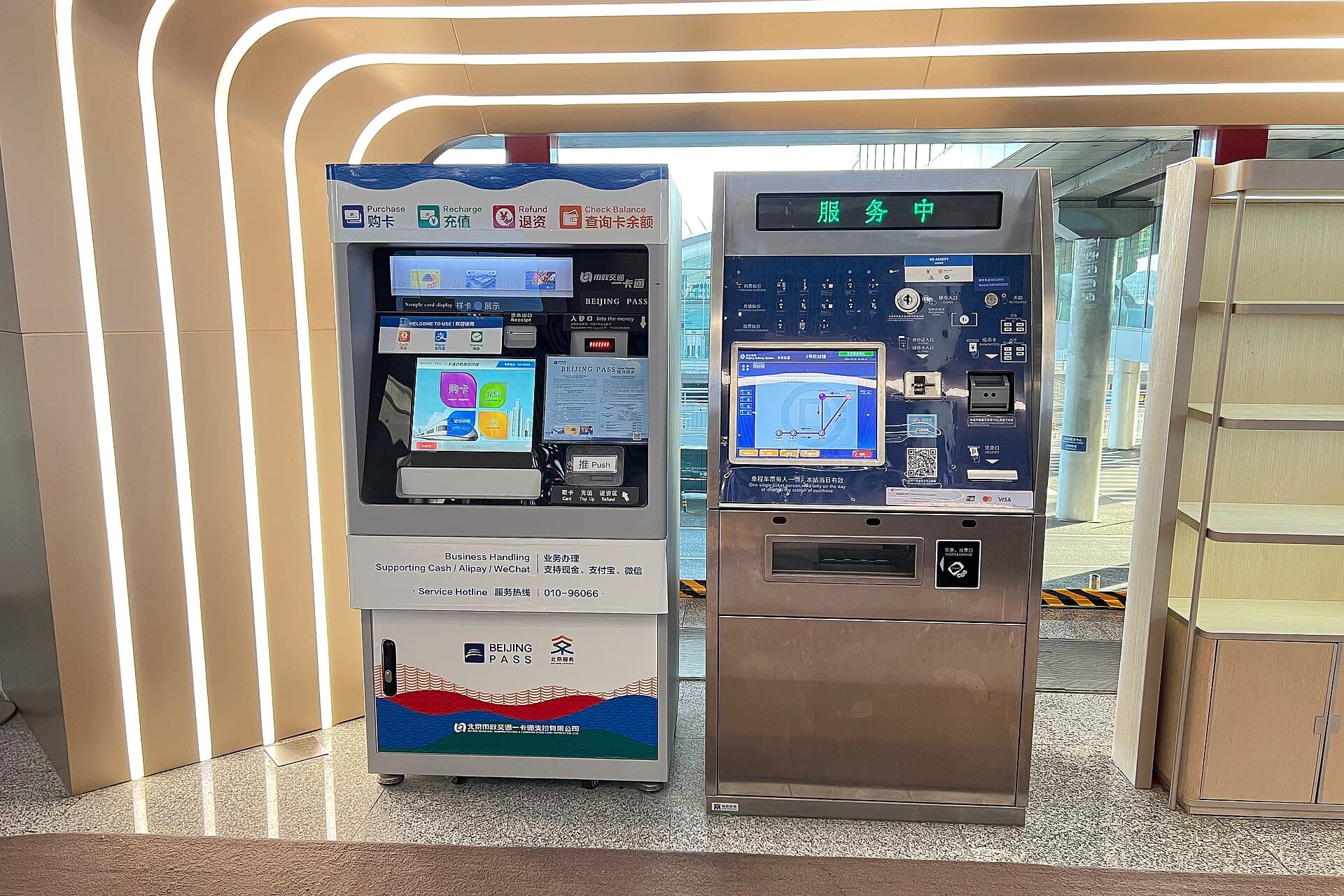
The last rung of the ticketing ladder below, standing in an arrivals hall: the Beijing Pass machine the city portal names as sold at the international terminals. Worth recognising before your phone is the only thing you have tried.
Photograph by N509FZ, CC BY-SA 4.0 — source and licence
City fares · read 2026-08-22
Both cities price by distance, and both city governments publish the bands themselves. Lines that price outside the ladder are listed separately, because the ladder does not cover them.
| Distance | Fare |
|---|---|
| Up to 6 km | CNY 3 |
| 6–12 km | CNY 4 |
| 12–22 km | CNY 5 |
| 22–32 km | CNY 6 |
| Over 32 km | CNY 1 more for every additional 20 km — no fare cap |
Priced outside the ladder
Also on the same official page
Published as About Subway Fares — Beijing Life on the Subway by Beijing Municipal People's Government official English portal (english.beijing.gov.cn), page credits Beijing Subway Co., Ltd. (2025-04-23 (publish time stamped on the page)).
Open source: About Subway Fares — Beijing Life on the SubwayPage read
| Distance | Fare |
|---|---|
| Up to 6 km | CNY 3 |
| Beyond 6 km | CNY 1 more for every additional 10 km |
Priced outside the ladder
Also on the same official page
Published as Metro — Travel Your Way by Shanghai Municipal People's Government official English portal (english.shanghai.gov.cn), page credits Shanghai Metro, the Shanghai Municipal Commission of Transport and the Shanghai Municipal Development and Reform Commission (2025-10-10 (portal path date)).
Open source: Metro — Travel Your WayPublished as Getting around Shanghai: Transport options and fares by Shanghai Municipal People's Government official English portal (english.shanghai.gov.cn), page credits Shanghai Metro and the Shanghai Municipal Development and Reform Commission (Updated on June 30, 2026 (stamp printed on the page itself)).
Open source: Getting around Shanghai: Transport options and faresPage read
Cities whose fares are not published here, and why
City transport bureaus · read October 6, 2026
Scanning is not the same price everywhere. Shenzhen's bureau names the ride code as excluded from the fare discount; Guangzhou's wrote that the discount must be available through a ride code. Same phone, opposite rule — here is each city's own document, with the clause.
| City | What a ride code pays | Published fare ladder | Read |
|---|---|---|---|
| Shenzhen (深圳)Full fare — no discount | A ride code pays the full fare. The 5% discount is tied to a physical card, and the bureau names ride codes, bank cards and other cities' transit cards as excluded from it. |
| |
| Guangzhou (广州)Same discount as a card | The opposite rule from Shenzhen: the city wrote that the discount must be obtainable by ride code as well as by card, with no discriminatory conditions. Read the lapse note — the document that says so expired on 2026-08-11. | None published | |
| Hangzhou (杭州)Not stated | Not stated here, because nothing official was opened. Hangzhou is named rather than left silent, so you know the gap is ours and not the city's. | None published |
| What it means for you | What the document states | Where in the document |
|---|---|---|
| The convenient way to pay is the full-price way | The bureau names four payment routes that get no fare discount at all: the Shenzhen Metro ride code, the Shenzhen Tong ride code, a financial IC (bank) card, and a national transit card issued by another city. A visitor scanning a QR code is paying more than the local beside them — not because of anything to do with being a visitor, but because the discount follows one specific piece of plastic. | 优惠政策·3地铁票价及相关政策 |
| The 5% discount needs a Shenzhen Tong card, or a transit card issued in Shenzhen | Tapping a 深圳通 card or a locally-issued national transit card takes 5% off the fare (票价9.5折). It is worth the price of the card only if you will ride a lot; for two or three rides, the ride code's convenience wins and the full fare is the cost of it. | 优惠政策·1地铁票价及相关政策 |
| A business carriage costs three times the ordinary fare | The business-carriage (商务车厢) fare is the ordinary fare for the same distance plus a usage fee equal to twice that fare — three times the ordinary fare in total. This is also the number behind the operator's rule elsewhere on this page that an international bank card must hold the network's highest business-carriage single fare before it will open a gate. | 商务车厢地铁票价及相关政策 |
| An overseas card bound in WeChat drives the ride code, and the fare comes off when you exit | The bureau's own sequence: bind the overseas card in WeChat, open the Shenzhen Metro mini-program, accept the ride-code service agreement, enable password-free payment, then hold the code to the gate reader. The fare is deducted after you exit, not when you enter — so a gate opening is not proof the payment settled. | 深圳地铁小程序实现“外卡支付”境外乘客坐地铁也能“扫码出行”了! |
| Foreign-card counter machines exist at eight named stations, not network-wide | From 2024-04-28 the operator fitted smart POS machines that take foreign cards at eight stations serving the airport, the main rail stations and the border crossings: Luohu (罗湖), Huanggang Port (皇岗口岸), Wenjin (文锦), Airport (机场), Futian (福田), Gangxia North (岗厦北), Shenzhenbei (深圳北) and Buji (布吉). They accept Visa, Mastercard, Discover, American Express, Diners Club and JCB, plus a digital-RMB hard wallet. This is a counter facility for buying a ticket at those stations — it is not a statement that your card taps on gates across the network. | 口岸、枢纽车站新增智能POS机境外乘客坐地铁也能“扫码出行”了! |
| Every station on the network has a staffed window that takes cash | The regulator states it plainly: staffed customer-service windows at all network stations are equipped to take cash, so that overseas passengers can buy a ticket through some channel. If the mini-program refuses your card and you are not at one of the eight POS stations, this is the way through — and it is the reason to keep notes on you for a first ride. | 全网车站人工客服窗口 · 现金境外乘客坐地铁也能“扫码出行”了! |
| A 2020-dated fare page is still the current one, and the price authority says why | Shenzhen prices its rail network as one system (同网同价), and when Line 13 phase two opened in 2026 the price authority priced it under the standing fare notice 深发改〔2010〕2488号 rather than issuing a new schedule. That is why a table dated 2020 is current evidence rather than a stale figure — the 2026 document points back at the old one instead of replacing it. | 深发改〔2026〕355号关于2026年13号线二期(北延)新线开通线网票价表的通知, 深发改〔2026〕355号 |
Fare ladder: Four bands, published by the transport bureau rather than the operator. The rate per kilometre falls as the trip lengthens, which is why a long Shenzhen ride stays cheap. For a station-to-station figure the operator runs its own lookup; the bands are what the regulator publishes.
Published as 地铁票价及相关政策 (Metro fares and related policy) by Shenzhen Municipal Transport Bureau (深圳市交通运输局), on its own public-information pages at jtys.sz.gov.cn — the city's transport regulator, not the metro operator (page-dated 2020-06-04, re-read and unchanged on 2026-10-06).
Open source: 地铁票价及相关政策 (Metro fares and related policy)Published as 境外乘客坐地铁也能“扫码出行”了! (Overseas passengers can ride the metro by QR code too) by Shenzhen Municipal Transport Bureau (深圳市交通运输局), reporting measures taken by 深铁集团 — a bureau notice, not an operator page and not a news reprint (published 2024-04-28, re-read and unchanged on 2026-10-06).
Open source: 境外乘客坐地铁也能“扫码出行”了! (Overseas passengers can ride the metro by QR code too)Published as 关于2026年13号线二期(北延)新线开通线网票价表的通知, 深发改〔2026〕355号 by Shenzhen Municipal Development and Reform Commission (深圳市发展和改革委员会), the city's price authority (published 2026-05-20 (read 2026-09-24, not re-opened this pass)).
Open source: 关于2026年13号线二期(北延)新线开通线网票价表的通知, 深发改〔2026〕355号Page read
| What it means for you | What the document states | Where in the document |
|---|---|---|
| A ride code must get the same discount as a card — that is written down | The measures set a 普遍性原则 (universality principle): fare-discount measures apply to all passengers, who may obtain them through a Yang Cheng Tong physical card, an NFC virtual card or a ride code alike, and discriminatory conditions may not be imposed. Put next to Shenzhen's exclusion list, this is the clearest proof on this page that “can I just scan?” has a different answer in each Chinese city. | 三(二)普遍性原则广州市公共交通票价优惠管理办法 |
| “The metro” here includes the trams, the APM line and the Guangzhou–Foshan line | The discount regime covers metro lines, trams, the APM line and the Guangzhou–Foshan line within the municipal area. Worth knowing before you ride: those are not separate systems you need separate thinking for, they sit inside the same fare arrangement. | 一(二)公共交通票价优惠范围广州市公共交通票价优惠管理办法 |
| A change to the discount scheme is posted publicly for at least 30 days first | A revised scheme must be filed with the transport bureau, the development and reform commission and the finance bureau, and publicly posted for no less than 30 days before it takes effect. Each round of discounts must also run for at least three years. So whatever scheme you meet is not something that changed overnight. | 四(一)票价优惠措施实施 · 三(四)稳定性原则广州市公共交通票价优惠管理办法 |
| The document itself expired on 2026-08-11, and nothing visible replaced it | 附则(三) gives the measures a five-year life from 2021-08-11, and the city's normative-document register marks them 失效 as of 2026-08-11. A search of the same register on 2026-10-06 turned up no successor. So the ride-code entitlement above is how Guangzhou wrote the rule, and the honest caveat is that the written rule has lapsed — ask at a station counter rather than quoting this at a gate. | 五(三)附则 · 基本信息 文件状态广州市公共交通票价优惠管理办法 |
Fare ladder: Still no Guangzhou metro fare table on any official page, three passes running — and now there is a sourced reason rather than a shrug. The bureau's own measures assign the drafting of the metro discount scheme to 广州地铁集团, the operator, under the bureau's rules; the bureau therefore publishes principles, not a fare schedule. Figures circulating in search results (the tiered monthly discounts) come from a municipal portal reprint of a 广州日报 story, which is a newspaper rather than the city stating a fare, so they are not published here.
Published as 广州市公共交通票价优惠管理办法 (Measures for Guangzhou public transport fare discounts), 穗交运规字〔2021〕7号 by Guangzhou Municipal Transport Bureau (广州市交通运输局), on the city's official register of normative documents 广州市行政规范性文件统一发布平台, 统一编号 GZ0320210075 (in force from 2021-08-11).
LAPSED. The register's own 基本信息 block states 失效日期 2026年08月11日 and 文件状态:失效, matching 附则(三) “有效期5年”. Read eight weeks after it lapsed; no successor document was found on the platform. Everything below is how Guangzhou wrote the rule, not a guarantee of what is in force today.
Open source: 广州市公共交通票价优惠管理办法 (Measures for Guangzhou public transport fare discounts), 穗交运规字〔2021〕7号Page read
Hangzhou (杭州) — nothing official opened, so nothing is stated
Fare ladder: No Hangzhou figure is published on this page. The municipal English portal (eng.hangzhou.gov.cn) and the city transport bureau (jtj.hangzhou.gov.cn) have not been opened yet and are the first targets of the next pass; the operator site hzmetro.com failed from this environment on 2026-09-28 and is not retried. Beijing's, Shanghai's or Shenzhen's numbers must not be read across — every Chinese city sets its own metro fare.
Page read
These rows come from two city transport bureaus' own pages — Shenzhen's fare-policy page and overseas-passenger notice, and Guangzhou's register entry for 穗交运规字〔2021〕7号 — plus the Shenzhen price authority's 2026 notice used only to show why a 2020-dated table is still current. They say what those two cities wrote down. They do not say what any other city charges a ride code: Hangzhou was not opened this pass, Chengdu's distance bands remain unconfirmed for the reason given in the operator table above, and Beijing and Shanghai sit in the fare tables higher up the page from their own city governments' English portals. Four more limits worth stating outright. Shenzhen's foreign-card POS machines are a ticket-counter facility at eight named stations, not a promise that a foreign card taps on gates network-wide, and the digital-RMB hard wallet named there buys a ticket at those machines rather than paying across the network. Shenzhen's fare page also carries a bus-to-metro transfer discount; this pass only recovered it as a summary line rather than quoted text, so no figure for it is printed here. Guangzhou's measures lapsed on 2026-08-11 with no successor found on the city's register, so the ride-code entitlement is quoted as what the city wrote, not as what is certainly in force. And no document opened here states which card schemes will work at a gate, or what any single station-to-station journey costs.
Operator ticketing rules · read September 19, 2026
The national policy above sets a target for hubs. Whether a given city's gate takes a foreign-issued card, on what terms, and what happens when the tap fails is written in each operator's own ticketing rules — so here it is per city, with the clause, and marked not stated where no official page could be opened.
| City | What the operator's page states | Where in the rule | Read |
|---|---|---|---|
| Shenzhen (深圳)Stated by operator | An international bank card rides on a pre-authorisation, and must hold at least the business-carriage network-maximum single fare The operator's rules list 国际银行卡 (international bank cards) among its ride media, alongside single-journey tokens, domestic financial IC cards and the national transit card. Riding on one is a pre-authorised transaction (预授权交易): the card must have available balance or credit of at least the highest single fare on the network for the business carriage (商务车厢) — a stricter floor than a domestic card gets, which is tied to the carriage class actually ridden. If the deduction fails for insufficient balance or limit, the system restricts that card's ride function rather than charging it later. The page does not say which card schemes qualify or which gates accept the tap, so this site does not either. | 车票使用规则 11 (and 6, 8) | |
| Chengdu (成都)Stated by operator | A bank card issued inside or outside the mainland is a recognised way to ride — a missed tap can be repaired for 7 days The operator's notice covers bank cards issued inside or outside the mainland (境内(外)发行的银行卡) as a way to ride. If a tap-in or tap-out is missing, the incomplete trip record can be completed up to the 7th day after the journey at a station self-service ticket machine or the station customer service centre; from the 8th day the network-maximum single fare for that record is deducted instead. Note the different failure mode from Shenzhen: Chengdu repairs and then charges the maximum, Shenzhen pre-authorises and blocks the card. | 票务须知·地铁篇 四.9 | |
| Guangzhou (广州)Not stated | Not stated — the operator's page could not be opened On 2026-09-19 the Guangzhou Metro operator's site refused every connection from this environment (TLS handshake failure on each method tried), and on 2026-08-22 the municipal portal offered only a 2007 fare page and reprinted news stories. No official Guangzhou statement on foreign-issued cards at the gate was read, so none is published here — and this page does not borrow the 'piloting, unreliable' line other guides use in its place. | — |
| What it means for you | What the operator states | Where in the rule |
|---|---|---|
| Exit within 210 minutes of tapping in | A passenger must enter with a valid ticket for the section and carriage class ridden, and exit the gates within the stated time limit of 210 minutes. Chengdu's limit on the same rule is four hours — two operators, two clocks, which is why this page does not print one national figure. | 车票使用规则 3 |
| One card, one person, one entry and one exit | The same ticket, card or code must be used to tap in and tap out, and a single card cannot carry several people through the gate. Handing your phone back over the barrier to a companion is the specific thing this clause rules out. | 车票使用规则 4 |
| Three named QR ride codes, and a broken tap must be self-registered | The operator names three QR products: 深圳市地铁乘车码 (Shenzhen Metro ride code), 深圳通乘车码 (Shenzhen Tong ride code) and 腾讯乘车码 (Tencent / WeChat ride code). If a QR ride leaves an incomplete entry or exit record, the system prompts the passenger to self-register the missing tap; left unrepaired, the fare is deducted under the network ticketing rules, and repeated deliberate gaps affect later riding and personal credit. | 车票使用规则 6, 9 |
| Luggage between 20–30 kg or 1.4–1.6 m combined needs a luggage ticket; above that it is refused | An item over 20 kg up to 30 kg, or with length + width + height over 1.4 m up to 1.6 m, needs a luggage ticket bought at the customer service centre at the same price as an ordinary-carriage fare. Over 30 kg, or over 1.6 m combined, may not enter the station at all — the rule an airport arrival with a large case meets first. | 车票使用规则 2 |
| A single-journey token is good only on the day it was sold, and is surrendered at the exit gate | A single-journey token is valid for travel only on the operating day it was sold; the exit gate takes it back, and one not handed over is treated as an invalid ticket. Receipts for an international-card ride are issued at the customer service centre before exiting, or from self-service ticket machines at some stations. | 车票使用规则 1, 6 |
Published as 车票使用规则 (Ticket Use Rules) — 深圳地铁 运营资讯 › 票务信息 by Shenzhen Metro Group Co., Ltd. (深圳市地铁集团有限公司), the licensed Shenzhen Metro operator, on its own site www.szmc.net — not the price authority (undated on the page itself).
Fare bands: Now published on this page, from a better surface than this one: the Shenzhen transport bureau's own fare-policy page carries the four distance bands, the business-carriage multiple and the list of payment methods excluded from the fare discount — see the ride-code fare table above, read 2026-10-06. This operator rules page itself still prints no bands; it names two fare classes, 普通车厢 (ordinary carriage) and 商务车厢 (business carriage). For an exact station-to-station fare, the operator runs its own lookup at www.szmc.net/shentieyunying/yunyingfuwu/chengchezhiyin/, and states that service is for passenger information only.
Open source: 车票使用规则 (Ticket Use Rules) — 深圳地铁 运营资讯 › 票务信息Page read
| What it means for you | What the operator states | Where in the rule |
|---|---|---|
| Exit within four hours of tapping in, or pay the network's highest single fare on top | After entering the gates a passenger must exit within four hours; overstaying is charged the highest single-journey fare on the network at the exit station in addition to the trip. Shenzhen's limit is 210 minutes. | 票务须知·地铁篇 四.2 |
| Tap in and out with the same ticket or the same app's code — apps cannot be mixed in one trip | Entry and exit must use the same ticket so the record is complete, and ride codes from different apps may not be mixed: whichever app opened the gate must close it. | 票务须知·地铁篇 三.2 |
| Riding on the Chengdu Metro app or Tianfu Tong is 10% off the single fare | The ways to ride the operator lists are the Chengdu Metro app (成都地铁APP), Tianfu Tong app and card (天府通), the Tianfu Citizen Cloud app (天府市民云APP), single-journey and commemorative tickets. App and Tianfu Tong riders get 10% off the single-journey fare plus a cumulative tiered discount; the base single fare itself is not printed on the notice. | 票务须知·地铁篇 一, 二.1 |
| Day passes: ¥20 for one day, ¥50 for three, ¥70 for five, valid from first tap | The operator's ticketing-policy list states three day passes on sale — one-day ¥20, three-day ¥50, five-day ¥70 — each valid from the first tap. Read from the policy list itself; the pass detail page was not opened. | 票务政策 · 日票 |
Published as 成都地铁票务须知 (Chengdu Metro Ticketing Notice) by Chengdu Rail Transit Group Co., Ltd. (成都轨道交通集团有限公司), the licensed Chengdu Metro operator, on its own site www.chengdurail.com — not the price authority (2025-07-27 (publish date printed on the page)).
Fare bands: Could not confirm the Chengdu distance-band fare table: the operator's notice says single tickets are charged under the basic fare policy (按基本票价政策) without printing the bands, and the price authority's notice sits on a gov.cn host this site could not open. Same status as on this site's Chengdu city-rules page, from the same source record.
Open source: 成都地铁票务须知 (Chengdu Metro Ticketing Notice)Page read
These rows are read off two metro operators' own ticketing rules — Shenzhen Metro Group's 车票使用规则 and Chengdu Rail Transit Group's 票务须知 — and each clause number points at the line it came from. They say what those two operators do with a bank card at their gates. They do not say which card schemes qualify, which lines or gates have the readers switched on, what the business-carriage maximum fare in Shenzhen is in yuan, or what either city's distance bands are — none of that is on the operator pages opened, so none of it is printed here. (Shenzhen's bands do appear higher up this page, read off the city transport bureau's own fare page on 2026-10-06; that is a different publisher and a different date, which is why it is a separate table rather than an addition to this one.) Guangzhou is listed as not stated because no Guangzhou page states a rule for a foreign card at the gate, not because the answer is no — the city's bureau document that did open on 2026-10-06 is about fare discounts, not about what a gate accepts. Beijing and Shanghai are not in this table: their layer on this page is fares, read from the city governments' portals, not operator gate rules.
Official regulation · read August 2, 2026
The ladder above is one city portal. These two are the regulation itself — the national payment-convenience Opinions that make card and cash acceptance mandatory at a transit hub, and the national complaint line — so they are what you can hold a station or a platform to.
| What it means for you | What the regulation states | Where in the rule |
|---|---|---|
| A major transit hub must, by rule, take mobile pay, bank card and cash — you can be given an alternative when the code fails | At scale-above transit hubs (交通枢纽站点) the policy makes it mandatory (必须) to be equipped to accept mobile payment, bank card and cash, and to guarantee the passenger's right to choose the payment method. So a foreign visitor whose metro QR code will not scan is entitled by national policy to a card or cash route at a large hub, not stranded at the gate — the ladder on this page is what the rule already says should exist. | Clause 二(四) |
| Foreign-card acceptance at transit hubs is a stated policy target, not a lucky accident | The Opinions name 交通枢纽站点 among the priority scenes where local governments must draw up merchant lists and push acceptance of foreign (境外) bank cards, and order card-clearing bodies to speed interconnection with international payment platforms. That is the official basis for 'a foreign card can be made to work here', versus a travel blog's say-so. | Clause 二(一) |
| The wallets that feed the metro code must be internationalized for foreign visitors | Mobile payment — the exact QR channel a visitor uses to scan into the metro through Alipay, WeChat Pay or UnionPay — must be given 国际化 (internationalized) service arrangements and an expanded acceptance range for 外籍来华人员 (foreigners in China). That is the regulatory reason foreign-passport binding on those wallets now exists, so setting one up before travel is working with the policy, not against it. | Clause 二(三) |
| Why there is no single national metro QR code or fare — the policy is locality-led by design | The Opinions repeatedly assign the work to 各地方政府 (each local government) determining its own priority-merchant lists and local rollout. That locality-led design is the sourced, non-enumerative reason each Chinese city runs its own metro ride code and sets its own fare, and why no honest page can quote one national metro QR or one national price — the mechanic the winning answers led with, here as a consequence of the rule rather than a claim about 200 operator sites. | Clause 二(一) |
Published as 《国务院办公厅关于进一步优化支付服务提升支付便利性的意见》 (Opinions of the General Office of the State Council on Further Optimizing Payment Services and Improving Payment Convenience), 国办发〔2024〕10号 by General Office of the State Council (国务院办公厅), document 国办发〔2024〕10号 dated 2024-03-01, full text in the national policy library on the Central People's Government portal 中国政府网 (www.gov.cn).
Open source: the State Council General Office Opinions 国办发〔2024〕10号, full text on gov.cnPage read
| What it means for you | What the regulation states | Where in the rule |
|---|---|---|
| 12328 is the transport industry's single national complaint and enquiry line — one number, not a per-operator desk | The plan defines 12328 as the transport industry's unified public-interest service-supervision line, whose functions are service supervision (服务监督), complaints and reports (投诉举报) and enquiries (咨询服务). It is built as a locality-run but networked 一号通 (one-number-nationwide) system, targeted to be live in every prefecture-level-and-above city by end-2014 — a real number a visitor can dial rather than hunting a city-specific operator hotline. | Sections 二(一) and 三(一) |
| Be honest about its scope: the opened plan covers surface transport; metro sits under a later measure | Per the plan's 功能定位, 12328's business domain is road transport, highways and waterways, and it redirects rail, aviation and post rather than handling them directly. Metro (urban rail) sits under 城市客运/城市公共交通, which is explicitly brought under 12328 by the 2023 管理办法 that was not opened this pass — so 12328 is offered here for transport-service complaints with that caveat stated, not asserted as verbatim-verified for a subway gate. | Clause 三(一) 功能定位 |
Published as 《交通运输服务监督电话“12328”实施方案》 (Implementation Plan for the 12328 Transport Service-Supervision Hotline) by Ministry of Transport (交通运输部), implementation plan (issued 2014-01-15) in the ministry's government-information-disclosure portal (xxgk.mot.gov.cn).
Open source: the Ministry of Transport 12328 implementation plan, full textPage read
This regulation layer is two documents read off their own official pages: the State Council payment-convenience Opinions and the Ministry of Transport 12328 plan. They set obligations on transit hubs and payment bodies and define the complaint line — they publish no metro fare number, so fares stay city-specific and, this pass, unconfirmed from any operator page; this layer states none. 12328's road/highway/waterway scope is quoted from the 2014 plan; metro is brought under it by the 2023 管理办法 not opened this pass, so metro applicability is written as a caveat, not a quote. Dialling 12328 as bare digits works locally, and from another province you prefix the destination city's area code — that is standard usage, not something the plan states. And the widely-repeated mechanic that the Beijing 亿通行 and Shanghai 大都会 apps have interoperated since 2020 and that one code works across ~18 cities appeared only in search snippets that could not be opened this pass, so it is not carried here.
Next move
Read enough to make the decision smaller, then open the checklist, search a specific question, choose a setup tool, or share the page with the person planning with you.
Use the checklist when the question has shifted from research to preparation.
Search by the actual problem: Alipay, eSIM, transit visa, first transfer, vegetarian food, or a city name.
Open recommendations when the task is clear enough for a short list to be useful.