Payment QR
Scan the code carrying the logo of the provider you intend to use. Prefer a merchant code: an international card added to Alipay does not fund person-to-person transfers or red packets.
QR code operating guide
By TravelerLocal editorial teamPublished Information checked
In short
Read the logo on the code and open that app — the central bank's own guidance is to scan the code carrying the logo of the payment service provider you intend to use. There are only 2 legitimate checkout modes: you scan the merchant's code, or the merchant scans yours. When a transport code fails at a gate, a contactless card usually works instead: Beijing documents Tap to Ride accepting UnionPay QuickPass and overseas-issued Mastercard and Visa.
Prepare payment fallbackApplies to
Travelers using Alipay, Weixin Pay, QR menus, metro QR codes, attraction tickets, mini-programs, table ordering, bike share, and receipts in mainland China.
Check before you rely on it
The rules quoted here come from the central bank's 2024 guide and from Beijing's and Shanghai's own pages, each linked with the date we read it. Transport facts are Beijing's and do not establish what another city accepts.
QR codes are the interface layer of modern China travel: payment, menus, metro, attraction tickets, mini-programs, receipts, and sometimes help. The trick is knowing which app the code expects and what replaces it when the scan fails.
Decision guide
A QR code can be a payment terminal, menu, ticket, mini-program, or account prompt.
Scan the code carrying the logo of the provider you intend to use. Prefer a merchant code: an international card added to Alipay does not fund person-to-person transfers or red packets.
Scan, translate, choose simple dishes, and ask staff if the mini-program requires a local phone number or an unfamiliar payment step.
Beijing's metro code lives inside Alipay. If it fails, Tap to Ride takes UnionPay QuickPass and overseas-issued Mastercard and Visa, and vending machines take Weixin Pay, Alipay, credit card or cash.
Shanghai's code sits in the Suishenban app, not in a wallet, and needs its own real-name check. Manual passport review is not instant, so treat it as an evening task.
Saveable checklist
In short
Short answers for QR payment, QR menus, mini-programs, transport codes, and first-day fallback decisions.
The central bank's visitor guide gives the rule: scan the code carrying the logo of the payment service provider you intend to use, so an Alipay-logo code is scanned with the Alipay app. The deciding signal is printed on the code rather than guessed. Restaurant menu codes and attraction or metro codes are separate flows and may expect the official app or a mini-program instead.
In Beijing, tap a contactless card instead. The city documents Tap to Ride accepting UnionPay QuickPass cards issued in China and overseas, plus overseas-issued Mastercard and Visa. Ticket vending machines are documented as taking Weixin Pay, Alipay, credit card or cash, and staffed counters and the Beijing Pass smart card are the other two documented entry methods. This is Beijing's own documentation and does not establish what other cities accept.
Common blockers include scanning with an app whose logo is not on the code, a personal transfer code rather than a merchant code, missing login, local phone number prompts, mini-program language limits, or weak data. A home e-wallet can also decline after the code scans: Alipay+ states the home wallet may still apply identity checks, payment limits or channel restrictions.
Probably not. The wallets published as directly usable in the mainland are from Hong Kong SAR and Macao SAR, Southeast Asia, and Japan, South Korea and Mongolia. No North American, European or Australian wallet appears on either the operator's list or the central bank's. Acceptance is signalled by the Alipay+ mark at the checkout counter.
No. Shanghai's city code is obtained inside the Suishenban app, not inside a payment wallet, and it needs its own real-name authentication — facial recognition for overseas Chinese passports and permanent residence proof, or manual review of a photographed foreign passport. Manual review is not instant, so do it at the hotel rather than at a gate.
Ask staff, use translation camera, switch to the app whose logo is on the code, request a paper menu or staffed counter, and keep a payment fallback. Each wallet also publishes an English-language support line, which does not depend on the app that just failed.
Use this for restaurant table QR, translation, spice, allergy, and payment fallback.
Open guidePrepare city-specific metro QR and ticket fallback before using transit.
Open guideUnderstand when QR payment fails because of foreign-card, network, or merchant mode.
Open guideThe published rule
The central bank's visitor guide instructs travelers to scan the code carrying the logo of the payment service provider they intend to use, and gives an Alipay-logo code scanned with the Alipay app as the worked example. The deciding signal is printed on the code.
You scan the merchant's code
You open the wallet, scan the code at the counter, and enter the amount yourself.
The merchant scans your code
You show your own payment code and the merchant's scanner reads it.
Source: Ant International — Alipay+ | Pay in the Chinese mainland (read July 24, 2026)
Source: People's Bank of China — Guide to Payment Services in China (2024 edition, page updated May 25, 2024; read July 24, 2026)
These screen names come from the guide's May 2024 edition, which has not been reissued, so they can lag the current app versions. Treat them as where to look, not as a promise about the wording on your screen.
Source: People's Bank of China — Guide to Payment Services in China (English edition, PDF) (May 2024 edition; read July 24, 2026)
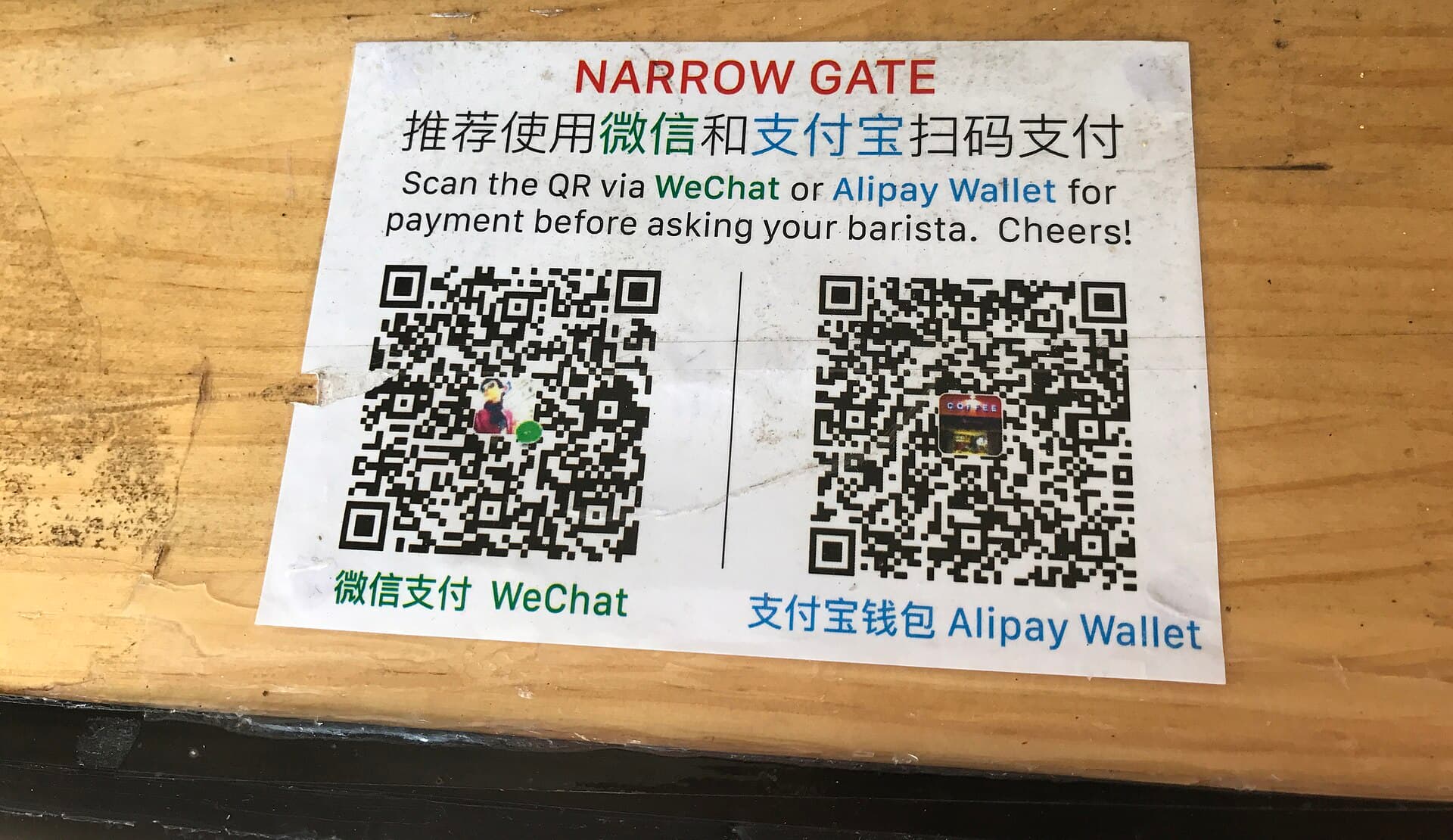
The pair you will meet at almost every counter. Which one you scan matters less than whether your wallet was set up and tested before you were standing here — and the national cash rule means a counter may not refuse notes if neither works.
Photograph by Harald Groven, CC BY-SA 2.0 — source and licence
From the authority itself
Embedded from the publisher’s own channel rather than a re-upload. Search results for any Chinese landmark are dominated by channels that took someone else’s footage; the videos here were checked back to the body that made them.
One Phone, All of Beijing
Under three minutes following one international visitor through a Beijing day on nothing but a phone — rides, hotel, attraction tickets, food, and paying at the counter. It is a promotional short rather than a walkthrough, so it will not teach you a single screen; what it is good for is seeing that the phone-only day is the normal one here, which is the thing that sounds implausible until you watch someone do it.
Published by Beijing Municipal Bureau of Culture and Tourism (北京市文化和旅游局) — its own YouTube channel, id UCkvkpj9ceJXqPs4Sj7jkwng on its own channel, which describes itself as “Welcome to the official channel of Beijing Municipal Bureau of Culture and Tourism.” Channel attribution verified .
This is the city authority's own promotional video, embedded from its own channel — it is not a source for anything on this page. Every figure, deadline and rule here comes from the official documents cited beside it, and those stand whatever a video shows.
Decision table
Beijing documents four entry methods plus a card tap. A contactless card is a better metro fallback than hunting for a ticket machine.
This is Beijing's own documentation of its network of 27 subway lines, including two airport lines, the Xijiao Line, the Yizhuang T1 Line and Suburban Railway Line S2. It does not establish what any other city accepts, and the page carries no fare table.
Source: Beijing Municipal Government — Basic Information of Beijing Subway (page identifier December 29, 2025; read July 24, 2026)
Shanghai's city code is obtained inside the Suishenban app rather than inside a payment wallet. Eligibility is stated as holding a foreign permanent residence ID card, a foreign passport, or a Chinese citizen passport for those settled abroad. Real-name authentication is done by facial recognition for overseas Chinese passports and permanent residence proof, or by manual review of a photographed foreign passport.
Manual review is not instant, so this is a job for the hotel that evening rather than for a queue at the gate. The page does not state which services or transport the code covers, and does not say whether the mobile number used at registration has to be a mainland one.
Source: Shanghai Municipal Government — Introduction to 'Shanghai QR Code' for foreigners (page identifier April 29, 2024; read July 24, 2026)
Acceptance for a home e-wallet is signalled by the Alipay+ mark at the checkout counter. The wallets published as directly usable are from Hong Kong SAR and Macao SAR, Southeast Asia, and Japan, South Korea and Mongolia. No North American, European or Australian wallet appears on either the operator's list or the central bank's.
Even where a home wallet is accepted, it may still apply its own identity checks, payment limits or channel restrictions, so a code that scans can still decline. Alipay+ states it adds no fee of its own and settles at rates it updates and discloses each business day.
Source: Ant International — Alipay+ | Pay in the Chinese mainland (read July 24, 2026)
Source: People's Bank of China — Guide to Payment Services in China (2024 edition, page updated May 25, 2024; read July 24, 2026)
English support lines
These published service numbers do not depend on the app that failed.
Ant International publishes staffed hours of 08:00-24:00 GMT+8, Monday to Sunday.
Published as a 24-hour line.
Source: People's Bank of China — Guide to Payment Services in China (2024 edition, page updated May 25, 2024; read July 24, 2026)
Source: Ant International — Alipay+ | Pay in the Chinese mainland (read July 24, 2026)
Next move
Read enough to make the decision smaller, then open the checklist, search a specific question, choose a setup tool, or share the page with the person planning with you.
Use the checklist when the question has shifted from research to preparation.
Search by the actual problem: Alipay, eSIM, transit visa, first transfer, vegetarian food, or a city name.
Open recommendations when the task is clear enough for a short list to be useful.